A failed authorization check can stop a Cloudflare edge service from starting. That safeguard sits at the center of the redesigned GeoKey Manager, now in closed beta. The beta opened October 23 to existing Data Localization Suite customers. Cloudflare announced the redesign on October 30, 2026, and plans general availability for the first quarter of 2027.
Where access stops
The design targets data sovereignty rules that limit plaintext processing to a region. It also addresses “harvest now, decrypt later” attacks, in which encrypted traffic captured today could be exposed if sufficiently capable quantum computers become available. Cloudflare authors Chetan Agrawal and Arka Nayan describe both requirements; Erik Engstrom is also an author of the post. Cloudflare says the service replaces the ciphertext-policy attribute-based encryption it has used since 2022 because that scheme has no production-ready post-quantum variant. The company also says customers do not need the large number of regions the policy system was designed to express.
The replacement uses HPKE, the hybrid public-main encryption construction defined in RFC 9180. It combines a main-encapsulation mechanism and a main-derivation function with authenticated encryption. Its main-encapsulation mechanism combines ML-KEM-768 with X25519. NIST finalized ML-KEM as FIPS 203 on August 13, 2024, specifying three parameter sets: ML-KEM-512, ML-KEM-768 and ML-KEM-1024. Cloudflare uses ML-KEM-768. HKDF-SHA-256 derives keys, and AES-256-GCM encrypts them.
Two main types replace policy expressions. A regional root main is a 256-bit symmetric secret, with one held for each region. From a root, the system derives an application-specific main pair for one service, such as Tunnel or Gateway, and one epoch. Cloudflare uses “epoch” for a main generation advanced through rotation. The main-management service derives the pair, then uses its public component to wrap customer private keys.
Separate main paths
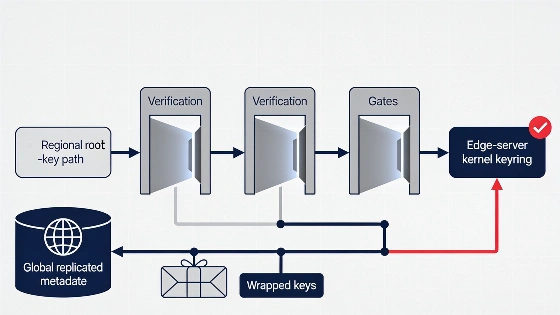
Wrapped keys and metadata travel through Quicksilver, Cloudflare's globally replicated main-value store. Regional root keys take a separate route through the provisioning service, which stores them in Vault. That keeps globally replicated wrapped-main material separate from regional root secrets.
Before an edge server receives a root main, its TPM hardware identity must be verified. Cloudflare's Zinc inventory then maps that identity to a data center and location. Separately, the provisioning service decides which regional roots the server may hold. Authorized servers load those roots into the kernel keyring, not onto disk. Cloudflare says “a machine restart removes the keys,” so the server must authenticate again. Regional membership refreshes several times a day as the network changes. That process is separate from main rotation and requires no customer action.
Cloudflare's epoch model also addresses a question from Dabeer Shaikh, a senior solutions engineer at HashiCorp, about rotating geo-fenced keys without downtime. A soft rotation creates a new epoch while keeping a limited number of earlier epochs usable during the transition. A hard rotation rewraps affected keys under a replacement epoch, then removes access to the old one.
Fail-closed tradeoff
Mark Tehrani, founder of CyberSeQ and a professor of cybersecurity, posted five questions on the announcement thread. He asked whether a compromised regional root main could expose data, whether compromised inventory or provisioning systems could send keys out of region, and whether a control-plane breach could change regional membership. He also asked: “If regional main provisioning, synchronization, or rotation fails, could the fail-closed design cause a region-wide service outage?”
Cloudflare's post says a failed service-context or region check rejects a request. An epoch mismatch does too. At the edge, a missing or malformed main prevents the service from starting. The authors call failing closed “a very intentional design choice.” The trust boundary includes the main-management and provisioning services, along with authorized edge main services. Quicksilver sits outside it because it holds only wrapped keys and metadata. This design is separate from the credential abuse covered in FAYFO's Cloudflare phishing report.
The redesign builds on Cloudflare's post-quantum work. InfoQ previously reported that the company adopted hybrid ML-KEM for its IPsec service in March, when more than 60% of human-generated TLS traffic on its network already used it. Cloudflare has also set out plans for a quantum-safe certificate authority. Most regions are expected to be covered at launch, subject to product-specific caveats.