Encrypted traffic intercepted today could be decrypted later as quantum computing advances, a risk known as “harvest now, decrypt later.” A related concern is “trust now, forge later”: sufficiently capable quantum computers could undermine digital signatures used to authenticate software, services and systems. That threat is driving urgency around post-quantum migration, particularly for information that must remain confidential for many years.
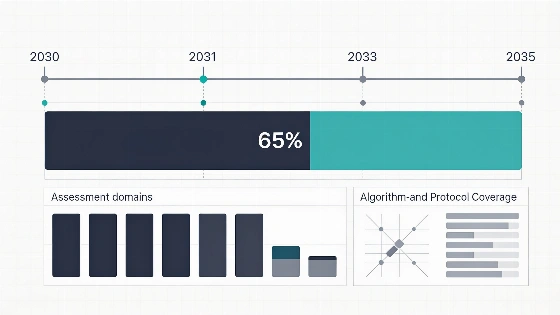
More than 65 percent of network traffic reaching Cloudflare used post-quantum key exchange as of April 2026. The figure covers traffic handled by a major infrastructure provider; it does not show how far cryptographic upgrades have progressed across individual organizations or the internet as a whole. Cloudflare did not identify a specific algorithm, so the figure does not establish that the traffic used ML-KEM. The company’s financial performance and valuation concerns are covered in a separate company analysis.
Deadlines are adding pressure. NIST’s post-quantum transition roadmap, NIST IR 8547, sets out a phaseout of quantum-vulnerable public-key cryptography: the algorithms are to be deprecated after 2030 and disallowed under NIST standards and guidelines after 2035. The final report was published on October 27, 2026. It points to FIPS 203 ML-KEM for key establishment and FIPS 204 ML-DSA and FIPS 205 SLH-DSA for digital signatures. The transition covers RSA, elliptic-curve signatures and Diffie-Hellman key establishment, including approved strengths such as RSA-3072 and P-256. Increasing classical key sizes does not remove the underlying quantum vulnerability.
For specified U.S. federal high-value assets and high-impact systems, guidance sets earlier milestones: post-quantum key establishment by December 31, 2030, and post-quantum digital signatures by December 31, 2031. These dates sit alongside the broader 2035 transition endpoint. The NSA’s CNSA 2.0 suite expects U.S. national security systems to use quantum-resistant algorithms by 2033. In Canada, federal departments face deadlines to migrate high-priority systems by the end of 2031 and the rest by the end of 2035.
For many organizations, the first obstacle is finding where cryptography is used. RSA and elliptic-curve systems can be embedded in applications, libraries, certificates, protocols, network devices, software dependencies and hardware, leaving security teams without a complete inventory to guide priorities. Traffic-level use of post-quantum or hybrid key exchange does not show on its own whether backend certificates, stored data, signing systems or supplier products have also been upgraded. Adoption is moving at different speeds across the broader digital ecosystem, even as large infrastructure providers move ahead.
SuperQubit Inc. introduced SQP Assess, a browser-based tool for measuring migration readiness across seven domains. Its exposure map covers more than 60 algorithms and 18 protocol families, pairing each with a recommended replacement. Timing checks model “harvest now, decrypt later” and “trust now, forge later” scenarios, using data lifespan and applicable deadlines to assess risk.
The tool also tracks supplier commitments, classifying them as committed, forecast, announced or unknown. Its overall maturity score runs from 0 to 5 and is set by the weakest-performing domain, so strength in one area cannot offset a gap in another. Seven sector-specific modules cover financial services, telecommunications, operational technology, critical infrastructure, government, digital assets and cross-sector organizations.
SuperQubit says results are encrypted and saved locally on an organization’s devices. The company presents an evidence-based assessment of current readiness as the practical starting point, before a large migration program begins.