
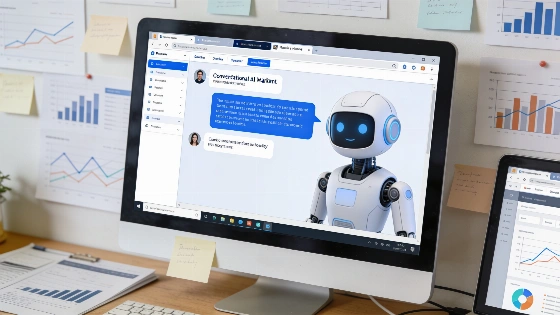
When Koah Labs serves an ad, it generally receives a user’s full chatbot conversation to help decide what appears. That context may improve targeting, but it also gives the ad technology company access to conversations people may treat as private.
Koah CEO Nic Baird says ads composed partly by AI generate twice the clicks of ads written entirely by humans across Koah’s network. The company works with brands including telehealth company Hims and flower delivery service UrbanStems, and says it places ads in more than 200 apps.
What the early data shows
Koah’s results offer an early signal in a format that larger platforms are also testing. OpenAI began testing ChatGPT ads in the United States on February 9, 2026, initially for eligible users on its Free and Go plans in selected regions. The company says advertisers receive aggregated reporting, including views and clicks. OpenAI has more than 100,000 customers advertising in ChatGPT since ads debuted there in February. Google expanded ads in its search chatbot AI Mode to 10 more countries beyond the United States. Google said users “find them highly relevant,” a company claim rather than an independent measure of performance.
Early performance figures point in different directions. A working paper by Maximilian Kaiser and Christian Schulze, summarized by Search Engine Journal, reported $0.89 in revenue per visit from a ChatGPT ad, compared with $2.45 per visit from a paid Google search ad. Digiday separately reported conversion rates of 0.37% for paid ChatGPT traffic and 1.17% for Google traffic. The comparisons measure different outcomes and are early observations, not a universal measure of ad performance.
Advertisers remain dissatisfied with the experience, according to the reporting, though they expect it to improve. Koah has attracted about one-tenth as many advertisers as OpenAI. For smaller chatbot companies, advertising could help cover the cost of generating responses, while the largest AI firms can draw on substantial venture funding or existing technology revenues.
The commercial route differs from earned visibility in AI answers, a subject covered in a related AI search report. Koah sells placements inside chatbot experiences; its targeting approach can use a conversation’s context to select or customize an ad. Baird says the prompt may be at least twice as long as a Google query, giving the system more information to work with. Google’s AI Mode ad guidance also describes contextual matching that can use a query together with the AI-generated response.
For example, Koah has seen spa ads perform well after prompts about stress. A Google search for help with stress might surface a therapist ad; Baird says Koah can also consider the AI platform’s response and the rest of the conversation. The company says users click about 3 percent of its ads, roughly on par with the more mature Google ads system.
Copy and control
Baird says AI-generated copy may feel more natural alongside an AI model’s answer. Koah grounds ads in product details and imagery supplied by advertisers, which can reduce the risk of the ad itself presenting invented product information. That does not remove the need for human review.
Drugmakers, for example, face government requirements about what their ads must or cannot say. Baird says those advertisers tend to keep more human control over the copy, with weaker results. Ad technology companies therefore have to make creative engaging without pushing risk-averse brands beyond what they can approve.
Conversation privacy
Koah says it anonymizes incoming queries and stores them in de-identified form. Baird declined to comment further on data collection and storage. The company generally receives the conversation up to the point when an ad is served, so the privacy question is broader than whether a single search term identifies a user. OpenAI, by contrast, says it keeps conversations private from advertisers and does not sell user data. Its ad policy says that turning off personalization can still leave ads based on the current chat thread, while excluding other conversations, ad history and inferred topics.
Baird argues that conversation context could help advertisers build a more relevant page after someone clicks an ad, such as by addressing a product detail the chatbot did not cover. Koah has no data showing whether users want those customized pages. Conversation history could also support retargeting, or showing an ad again to the same user.
Ads beyond chat
Koah estimates that one in four chatbot queries about a retailer or brand involves a return, exchange, or another support issue. Baird sees an opening for companies to surface warranty information or guide dissatisfied customers toward AI-mediated support. An ad might help someone reach a resolution sooner; it could also waste the advertiser’s money and leave the customer more frustrated.
Koah’s current ad-supported apps do not offer shopping agents that make purchases on a user’s behalf. Apps such as Instinct and Meta’s Muse are beginning to take on shopping tasks for some users. Meta CEO Mark Zuckerberg has said Muse could become the company’s biggest revenue source, while suggesting transaction fees rather than ads would generate that money.
Initial studies suggest ads could influence AI agents. Baird says an advertiser could try to give an agent the best recommendation through a relevant product and a strong discount. He also says the chatbot must make sponsored material “abundantly clear” to the agent to protect user trust.
Anthropic has reaffirmed its Super Bowl commercial pledge to keep Claude ad-free. Its IPO filing did not mention advertising, and the company has about $112 billion in investor cash. DeepAI CEO Kevin Baragona said ad revenue has been meaningful but that he is not committed to the format. “I don’t think the ads are working terribly well for anyone,” he said.
Google’s AI Mode expansion took effect on October 28, 2026, adding Australia, Canada, India, Kenya, Malaysia, New Zealand, Nigeria, Pakistan, the Philippines and Singapore. Existing Search, Shopping and Performance Max campaigns can be eligible to appear in AI Overviews and AI Mode without a separate campaign or budget, and Google introduced multiturn ads in the United States that can appear during follow-up questions. The expansion is described in PPC Land’s report.








