
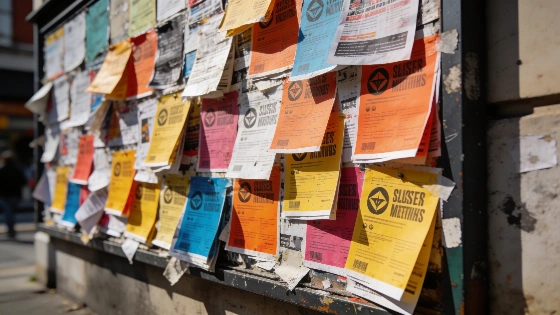
Media professionals and content creators face a new challenge as AI-generated flyers, often made with ChatGPT, spread across digital and physical spaces. They are now common on social media and in local neighborhoods, and even appear on billboards, prompting questions about design quality and audience engagement. Generative tools let people produce promotional copy and layouts built around images quickly. Small operators and event organizers can create multiple versions without hiring a designer.
Many users say they began noticing these AI-created flyers only after seeing a few, but now spot them everywhere. Surf lesson ads in California are one example; party invitations, concert posters and business promotions are others. Advertisements for drug delivery have appeared in Berlin, while France has seen World Cup party flyers and South Carolina junk-hauling services have used them. The trend has sparked viral posts and parodies, with some creators frustrated by the lack of originality and effort.
Graphic designers and musicians, along with bar owners and small-business operators, have voiced concerns about generic flyers’ effect on their brands and events. A typical example has bold, bright text against a dark background, alongside AI-generated or altered images and a box of generic icons. Bulleted lists and emphasized words, whether underlined or bold, can make information easy to scan. Arrows, checkmarks and lines also draw attention to basic details. But repeated use of these elements can make individual events and businesses harder to distinguish.
Posts on Threads and social media say some users now refuse to attend events promoted with these AI-generated designs. Others say they will not donate to or share them. The conversation is especially active among people who value thoughtful design and want promotional materials to show genuine effort. Their concern extends beyond whether an image looks synthetic: repeated templates can make a campaign feel less distinctive, while realistic synthetic people raise separate questions about authenticity.
Consumer attitudes suggest that disclosure and trust are part of the debate. In the “Authenticity Audit,” Cint and Advertising Week surveyed about 1,000 U.S. consumers. Roughly three in four respondents said brands had a duty to disclose AI use in advertising and marketing. The survey also found that 44% said discovering undisclosed AI advertising would reduce their trust in a brand. AI-generated people stood out as a disliked synthetic element, identified by 46% of respondents.
Rules do not treat every use of AI in an advertisement the same way. Under Article 50 of the EU AI Act, providers must mark certain AI-generated audio, images, video and text in machine-readable form. Deployers must disclose certain AI-generated or manipulated content that qualifies as a “deep fake.” The relevant transparency obligations are scheduled to apply from 2 August 2026, with an additional transition period for some marking duties covering systems already on the market. The law does not require a visible label on every advertisement that involved any AI assistance; requirements depend on the type of content and how it may be understood. The rules are set out in the EU AI Act.
European Advertising Standards Alliance guidance treats disclosure as separate from the basic requirement not to mislead consumers. It asks advertisers to consider how extensively they used AI and how realistic the result appears. They must also weigh how impressive the AI-generated element is to a consumer’s understanding of the ad. A flyer produced largely through ChatGPT may so raise different disclosure questions from one using AI only for a minor background edit. As the guidance puts it, “Disclosure of AI use does not replace the basic requirement that advertising must never mislead consumers.”
In the United States, no single federal rule requires every AI-assisted commercial flyer or advertisement to disclose generative AI use. The Federal Trade Commission’s existing rules against deception and misleading endorsements still apply when synthetic content creates a false impression about a product or person. They also cover testimonials and experiences. Its 2024 rule on fake reviews and testimonials separately prohibits deceptive consumer endorsements, including fabricated or manipulated testimonials. The FTC’s consumer-protection structure holds advertisers responsible for advertising claims, even when an agency, platform or AI vendor supplied the production tools. The agency’s rule on consumer reviews and testimonials addresses one specific risk: fabricated endorsements presented as genuine consumer experience.
Platforms apply their own labeling practices alongside government regulation. Meta may display an “AI info” label on images or videos created or significantly edited with its generative tools. It also applies additional treatment to some photorealistic synthetic people and to political or social-issue advertising. Those systems focus on detectable media and policy-defined categories, not every use of an AI assistant for brainstorming or copy and layout. A text-heavy event flyer made with ChatGPT may so circulate without the automated label applied to a photorealistic AI-generated person.
The immediate trade-off is between speed and distinctiveness. Generative tools can cut the time and cost of producing promotional material, but repeated layouts and synthetic imagery may make campaigns feel generic or less credible. Regulation is moving toward targeted transparency alongside continued action against deception, not a blanket ban on AI-assisted advertising. For businesses and organizers, the practical challenge is to make flyers useful and efficient while retaining the details and visual identity that help an event stand out and earn credibility.








