Bookstores and publishers are no longer the only way readers find new stories. More people are turning to artificial intelligence for their next dose of fiction, and the most dedicated among them are doing more than just reading-they're shaping the stories themselves, one prompt at a time.
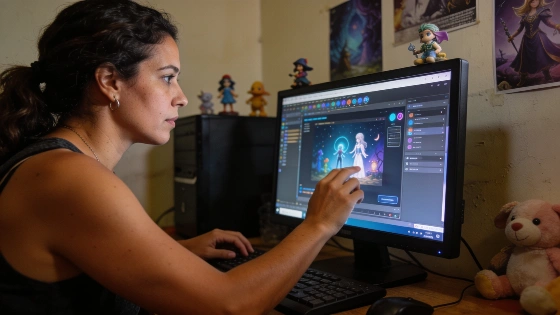
Petra Ferraz de Novaes, a 36-year-old software engineer in Brazil, is part of this shift. She spends hours lost in fantasy worlds created by open-source AI models running on her own computer. With SillyTavern, Novaes sets up wild scenarios-an elven warrior taking on the queen of the Amazons, or a Star Wars-inspired quest-then lets the model run with it, enjoying the unexpected turns. "What fascinates me is the unpredictability," Novaes says. "People say that AI hallucinates a lot. But in this case, it’s probably what you want."
Public research on the WildChat dataset found that more than a third of all prompts were related to fiction, with a small group of power users generating the majority of this content.
While the publishing industry deals with scandals over suspected AI-written novels and canceled book deals, something else is happening in parallel. A University of Washington study found that over a third of prompts submitted to ChatGPT in the WildChat dataset were for fiction-everything from fan fiction and poetry to erotica and role-play. Most of this activity comes from a small group of "power users," some of whom generate thousands of story variations in just a few months. Even after accounting for these heavy users, at least 7 percent of chatbot users are actively generating fiction, according to University of Washington research publications.
For some, the draw is creative control. AI models let users tweak stories instantly, steer the plot, and even put themselves into the narrative. Others, like Razrien, a 40-year-old from Indiana, use AI to explore fantasies that traditional media ignores. Razrien's favorite models create everything from "big angry rat wife" characters to towering werewolf matriarchs, all tailored to his tastes. "I have a thing for large, angry women slapping me around. Some models are perfectly good for that," he says. "I like my big rat wife. I love her to pieces. Even if she sometimes breaks me apart and heals me back together. But hey, that’s how she says she loves you."
AI’s narrative playground
Researchers like Melanie Walsh and Neel Gupta see the rise of AI fiction as more than a technical novelty. The WildChat dataset, while not fully representative, points to a dedicated audience that values speed, customization, and judgment-free storytelling over the traditional author-reader relationship. "These models are judgment-free; they can produce stories instantaneously; they are nearly inexhaustible," Walsh notes.
WildChat has also served as a foundation for research into user behavior and personalization. One study noted that RLHI models trained on WildChat data improved both personalization and instruction-following compared to RLHF approaches.
Chuanyang Jin - Publications
OpenAI’s own research, published in 2025 with the National Bureau of Economic Research, puts the share of fiction-related prompts at 1.4 percent-lower than the WildChat estimate, but still notable given ChatGPT’s huge user base. OpenAI’s figure excludes role-play and may miss some erotica, so the real appetite for AI fiction could be higher.
Despite their popularity, current AI models still struggle with long stories and literary style. They do well with genre fiction built on familiar tropes but have trouble with ornate prose or complex character arcs. As models improve, researchers expect a split: mass-market AI fiction for most readers, and a smaller niche for experimental, human-written work.
Redefining the reader’s role
For Novaes, AI storytelling isn’t a replacement for books-it’s her way into reading. She now seeks out other people’s AI-generated stories online, something she never did with traditional novels. "I was never much of a book reader," she admits. "But now I do read other people’s stories. These are the only novels I’m reading."
This new ecosystem turns the old literary hierarchy upside down. Instead of just consuming an author’s vision, readers become co-creators, shaping stories to fit their own interests. The result is a digital choose-your-own-adventure with endless branches, limited only by the user’s imagination.
Some traditionalists worry about losing the author-reader bond, but the numbers are clear: a sizable group of readers wants entertainment on their own terms, without literary conventions or editorial filters. As AI models get better, this audience is likely to grow-and the publishing industry will have to compete with the very technology it once dismissed.
Recent experiments show that readers often rate AI-generated stories more highly when they think a human wrote them, but engagement drops and skepticism rises when the AI origin is revealed, as reported in a World News Intel feature on AI storytelling.