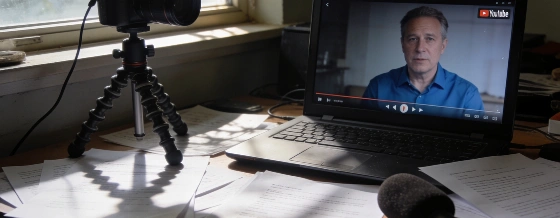
Millions of Americans are watching political news videos fronted by paid actors and scripted by AI. A new breed of YouTube operators is cashing in on algorithmic virality, fueling misinformation and reshaping digital media economics.
On YouTube, paid actors reading AI-generated scripts have become the faces of a sprawling network of political news channels, quietly drawing tens of millions of views while avoiding platform detection. These operations, run by digital entrepreneurs with no direct political ties, use algorithm-driven engagement to turn outrage and misinformation into profit. Major media outlets and political figures are struggling to keep up.
NPR reported in August 2026 that deepfake impersonations of celebrities like Jimmy Kimmel and Jon Stewart were spreading rapidly online, highlighting how synthetic content is now a cross-platform phenomenon.
Behind the scenes, companies like Virelox and Casgains, founded by Caleb Chan, have built systems capable of launching hundreds of channels and thousands of videos each week. Chan, a University of Chicago graduate, has openly promoted his "ghost creator" model, claiming 2,500 organic videos weekly and billions of monthly views. His network dashboard tracked channels labeled "anti-Dem," and his public posts described tactics for gaming YouTube’s trending algorithm, such as synchronizing uploads across dozens of accounts to trigger "breaking news" status.
Algorithmic gold rush
The financial motive is obvious: one network linked to these growth-hacking outfits has pulled in over 45 million YouTube views and 90,000 comments, with millions more impressions on TikTok. The audience is mostly American, male, and over 55-a group advertisers want but traditional newsrooms often miss. For small media operators, the formula is simple: follow the algorithm, recycle scripts, and collect ad revenue that once went to legacy publishers.
Semafor's August 2026 reporting first identified AI-generated or AI-assisted political content on YouTube, including videos spreading false claims about company closures. The subsequent September investigation revealed a broader network using paid actors to front these synthetic news channels, further complicating platform enforcement efforts.
Political staffers and researchers have noticed. Brandon Richards, spokesperson for California Gov. Gavin Newsom, described a landscape where algorithms reward falsehoods and rage-bait, warning that the mix of bots, AI, and doomscrolling habits has made it easier than ever to push divisive narratives. YouTube has removed some channels after violations, but the sheer volume and adaptability of these networks make enforcement nearly impossible.
Researchers at Riddance AI, a company tracking synthetic content, identified a dozen interconnected channels using real actors to avoid YouTube’s AI labeling. They found recycled music, identical script phrases, and even actors switching roles across channels-like "Felmon," who moved from anti-Trump to anti-Democrat content under different brands. Payment trails led back to Casgains, with actors confirming they were hired through brokers and had little idea who the real client was or what the editorial agenda might be.
Manufacturing news, not reporting it
The content strategy is built for efficiency. Videos often start with vague stories about Democratic politicians, followed by exaggerated or false headlines-like claims of celebrity departures or economic collapse. Scripts are formulaic, with repeated phrases and recycled storylines, all designed to maximize watch time and trigger algorithmic promotion. Even background music and video structures are reused across different personas and channels.
Attempts to trace the real operators behind these networks reveal a tangle of aliases, cross-linked bios, and shifting identities. Some actors, like Kareem M. Maize ("Omar"), admitted to using false locations and outsourcing editing overseas. Others, like Frank George ("William"), described the work as paid advertising, not journalism. Despite public denials of political coordination, internal dashboards and casting calls show a clear focus on anti-Democrat narratives and a relentless push for viral reach.
For established publishers, the impact is clear. These AI-powered, actor-fronted channels are siphoning engagement and ad dollars from traditional newsrooms, sometimes outpacing major outlets like The Washington Post and The New Yorker on YouTube. Low production costs and high scalability mean a handful of operators can dominate the attention economy with little oversight. As reported earlier, digital publishing is already under pressure from shrinking ad supply and changing audience habits-this new wave of synthetic news only speeds up the disruption.
Editorial judgment
The rise of these "ghost creator" networks marks a shift in digital media. The old reliance on editorial standards and fact-checking is being outpaced by algorithm-driven operators who treat news as a product to manufacture. Platform enforcement is reactive and easy to evade, while the audience-older, politically engaged, and often less digitally savvy-remains vulnerable to manipulation. These operations are run by profit-seeking growth hackers, not political operatives or foreign actors, which only adds to the challenge. Unless platforms, advertisers, and publishers adapt quickly, the economics and credibility of online news will keep eroding, leaving the public sphere shaped by those who best exploit the system’s blind spots.