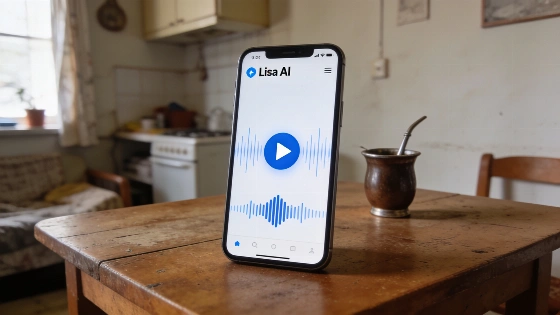
Two 23-year-old engineers built Lisa, a free AI audio app that quickly climbed Argentina’s news app rankings. It charges no fees or carries ads, and legacy media did not back it. In a country where traditional news outlets are losing young readers, the app’s rise is hard to ignore.
Lisa launched in August and, within days, became the most-downloaded app in both News and Magazines & Newspapers on Argentina’s Apple App Store. By September 30, it had reached the country’s top 100 overall downloads, co-founder Valentín Virasoro said. Seventy percent of users interact with Lisa after downloading it. Audio briefings have a 90% completion rate, while 80% of users return the next day. Virasoro and co-founder Iván Schahovskoy Hoferek have not shared total download figures, but journalists are already using Lisa to track their own beats. The app is available on Android and iOS, with a web version, and aggregates news from about 80 Argentine media outlets.
Lisa keeps things simple. Users choose topics and set their interest levels, and the app’s AI scans dozens of Argentine news sites for matching stories. It then creates a 10-minute audio newscast that summarizes reports and names the original sources. Only free news sites are included; paywalled content is left out. Users can receive up to two briefings a day, each with a chat feature and direct links to cited stories. The app’s voice uses voice-cloning technology and sounds calm and distinctly Argentinian.
Lisa costs nothing: there are no subscriptions or ads. Five volunteer engineers and developers make up the team, alongside two advisors. Angel investors provided the initial funding, and neither founder takes a salary. The app works worldwide, though it currently draws news only from Argentina. Virasoro and Schahovskoy are not rushing to monetize it; they say they may eventually help news outlets earn revenue through Lisa. Three outlets have already asked to join its reading list. Reporting by iProfesional said Lisa had surpassed 10,000 users shortly after launch and remains free for users and participating media outlets.
Changing habits
Lisa’s roots go back to Virasoro’s former job at a Córdoba car dealership, where his boss sent daily audio updates about car news. Virasoro kept listening to those voice notes after moving into tech. The habit sparked Lisa’s basic idea: deliver news in formats young people use, including podcasts and algorithm-driven feeds. Schahovskoy and Virasoro saw a gap: journalists cover topics people care about, but no tool surfaced that information in a smooth, personalized audio stream.
Lisa responds to shifting news habits. The Reuters Institute for the Study of Journalism found that 46% of Argentine adults avoided news in 2026, while trust in news fell to 26%. Nearly one in ten Argentinians now get news from chatbots. Young people are turning to YouTube, as well as creators and independent journalists. Globally, 52% of young adults get news through chatbots; many also use video platforms and social media. Podcasts remain popular, with 11% of adults using them for news.
Virasoro and Schahovskoy see the shift to algorithmic and creator-driven platforms as a problem: editorial curation is missing, and misinformation spreads fast. Their goal is to connect professional journalism with formats that appeal to younger users, reducing friction while building trust in verified information. Lisa is not meant to compete with news outlets; it is a tool to help them reach new readers.
Legal and editorial boundaries
Lisa’s content model follows Argentina’s intellectual property law. The law allows apps to use and share news content within reason, provided sources are clearly named. Up to 1,000 words can be used for educational or scientific purposes, including informational use, while republication of full articles is banned. Lisa’s AI summarizes and credits stories without republishing full articles. The setup matches copyright rules in other countries and aims to respect publishers’ rights.
The founders want to keep improving Lisa before considering monetization. They are open to partnerships that help news outlets earn money inside the app. For now, they are focused on user experience and editorial standards. Their approach aligns with recent coverage of AI audio’s effect on publisher strategies and the changing ties between platforms and content creators.
Traditional media in Argentina is losing advertising revenue and trust. Lisa’s early momentum suggests small, fast-moving teams can reach audiences by meeting them where they are. The app’s high engagement and positive feedback from journalists point to a promising response. Its founders are betting on frictionless, trustworthy delivery, without paywalls or clickbait.