Unexpected stops and confusing maneuvers from autonomous vehicles may soon be easier to understand. A new system from Motional and MIT translates AI decisions into plain language, giving both regulators and riders a clearer view of what the car is doing and why.
When a self-driving car brakes suddenly for no obvious reason, it leaves riders and bystanders guessing. Now, for the first time, engineers can see exactly what triggered the AI's decision-down to the specific concept behind it. Motional and MIT have introduced a system that makes the logic of autonomous vehicles visible on the dashboard.
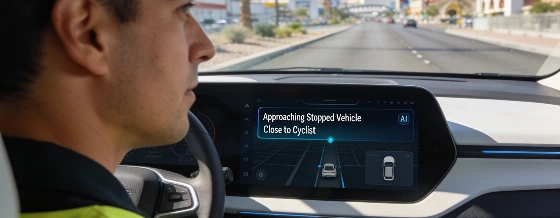
Instead of vague explanations or after-the-fact guesses, the Concept-Wrapper Network (CW-Net) gives real-time, direct explanations. If the car brakes, the dashboard might show "Approaching Stopped Vehicle" or "Close to Cyclist," tying the action to the AI's reasoning. This system is a response to growing calls for transparency as self-driving cars appear in more cities and on more roads.
“In controlled track tests, safety drivers using CW-Net were significantly better at predicting the vehicle's next move compared to those without access to the system.”
MIT News
Most explainable AI research for self-driving cars has stayed in the lab or in simulations. Motional and MIT took CW-Net onto real streets in Las Vegas, with a safety operator ready to step in. The results were immediate. In one test, the car kept stopping near a traffic cone. The operator thought the cone was the problem, but CW-Net showed the AI was actually "seeing" a stopped vehicle that wasn't there-a bug in its training data. Removing the cone didn't help, but the new system let engineers track down and fix the issue.
In another case, the car stopped for a cyclist as expected, but CW-Net revealed that the main planner wasn't reacting to the cyclist at all. Instead, a backup safety system had triggered the stop. This detail led the safety driver to be more cautious, and a follow-up confirmed the planner's blind spot. Without CW-Net, this gap would have gone unnoticed, putting safety and trust at risk.
Adding explainability often slows down AI systems, but Motional's tests showed less than a one percent drop in driving performance compared to top algorithms. For engineers and operators, knowing whether a stop was caused by a real hazard, a false alarm, or a backup system means they can diagnose problems faster and respond more accurately. As regulators push for more openness, Motional expects tools like CW-Net to become standard in autonomous vehicles, drones, and even robotic surgery.
“CW-Net translates the AI's internal signals into human-understandable categories, such as 'approaching stopped vehicle' or 'close to cyclist,' and ensures these explanations are causally linked to the car's actual decisions. In simulation studies with non-expert users, these clear explanations improved people's ability to predict the car's next maneuver and helped them spot system errors more quickly.”
MIT News
For digital publishers and AI developers, the message is clear: black-box models may work well, but without clear explanations, trust and adoption stall. As reported earlier, hidden flaws in AI logic can go unnoticed until they cause real problems. Motional's approach-linking every AI action to a human-readable cause-raises the bar for accountability in automated systems. Explainability is no longer a bonus feature; it's becoming a requirement. The next generation of AI products will be judged not just by what they do, but by how clearly they can show their reasoning.
According to MIT News, CW-Net was tested in both simulations and real-world driving on a private track, where safety drivers could better anticipate the car's actions. The system gives engineers valuable feedback for debugging and helps them quickly find the root causes of planning failures.
A Nature editorial points out that CW-Net tackles a key challenge in explainable AI for self-driving cars: helping people tell when the car is reacting to a real obstacle and when it's making a mistake or "hallucinating." This level of transparency is expected to be important as self-driving technology becomes more common in daily life.
Motional, founded in 2020 as a joint venture between Hyundai Motor Group and Aptiv, employs over 1,000 people and runs autonomous vehicle fleets in several U.S. cities. The company has raised more than $1.6 billion and is a major player in the push to commercialize self-driving technology, with ongoing partnerships and pilot programs across North America.