
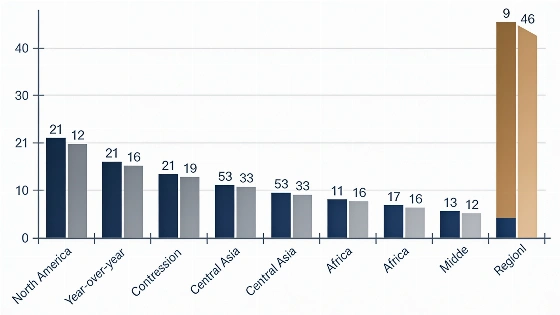
Nine of the ten regions in Chartbeat’s latest audience data lost search share year over year. The North American figure fell to 12% in the Q3 2026 report, released October 15, from 21% in the Q3 2025 report. The Chartbeat report describes the regional share of page views coming from search engines.
The decline was widespread, though its scale varied by region. Central Asia had the steepest drop, falling from 53% to 33%. North America and the Middle East each lost nine percentage points. Africa moved in the opposite direction: its search share rose from 41% to 46%.
A Steep Slide
North America’s nine-point annual decline was concentrated in late 2025. Five points came between Q3 and Q4, when the region’s share went from 21% to 16%. It then reached 13% in Q2 2026 and 12% in Q3.
That is a useful benchmark for publishers comparing their own search share with other publishers in Chartbeat’s network. It does not reveal how many search page views a site gained or lost on its own.
What The Share Measures
Chartbeat presents search as a proportion of each region’s total page views. That proportion can shrink if search sends fewer views, if other sources send more, or if both changes happen together. The chart alone cannot distinguish among those possibilities.
The Q3 2026 report gives no specific overall page-view total alongside its statement that “overall traffic to publishers in the Chartbeat network remains steady.” Chartbeat used the same sentence in its Q4 2025 report. Neither Q3 report says how many websites contributed to the figures or whether the same sites were included in both years.
Chartbeat sells analytics tools to publishers. Its Q3 report ends with an invitation to request a demonstration, but it provides no additional detail about the sites behind the regional comparisons.
AI Is One Possible Factor
The Q3 report does not explain why search share fell. Chartbeat’s Q4 2025 report described the decline as “likely a result of AI’s growing impact on search.” Its Q1 2026 report also said the change was likely partly due to AI’s effect on content discovery. Those are the company’s explanations in earlier reports; the latest report does not establish a cause.
A Pew Research Center study published July 22, 2025, analyzed browsing histories from 900 U.S. adults and 68,879 Google searches made in March 2025. AI Overviews appeared in about 18% of the searches. When an overview appeared, users clicked a traditional search result in 8% of visits, compared with 15% when there was no overview; they clicked a link within the overview in 1% of visits where it appeared. Pew also found that users ended their browsing session after the results page in 26% of visits with an AI Overview, versus 16% without one.
Chartbeat groups search engines such as Google and Bing into one category in these regional charts, so the figures do not isolate Google Search. Chartbeat’s 2026 Publisher Playbook reports Google Search separately for the full network and was covered here in September. The broader publisher concern over AI and content access also appears in our report on AI scraping.
For North American publishers, the available year-over-year comparison is 21% in Q3 2025 against 12% in Q3 2026. A publisher can compare its own search share with that network figure, while keeping in mind that the reports do not confirm a consistent website sample.








