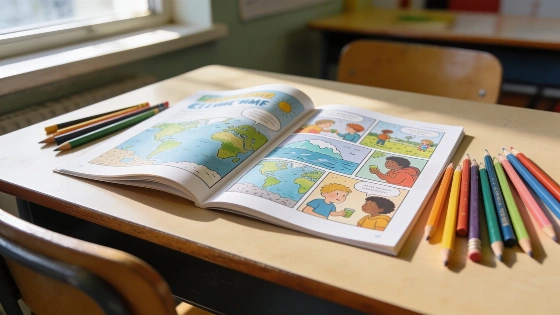
Media organizations and educators looking to engage young audiences on climate issues now have a printable comic designed for children ages 6 to 12. It explains climate change in accessible language and addresses the emotional impact that news about extreme weather and environmental shifts can have on children.
The risks children face underscore the need for climate communication designed for them. UNICEF’s 2026 climate-risk reporting estimates that about 1.1 billion children are highly exposed to climate threats, while nearly all children worldwide face at least one such hazard. The cited figures include roughly 2 billion children living in areas with unhealthy air quality. Another 1.8 billion are exposed to drought, and 1.2 billion to extreme heat. UNICEF’s climate and environment work examines how these hazards affect children’s health, nutrition, education and access to impressive services. Amy Wickham, UNICEF’s Educational and Climate Lead in the Global Program Division, said that “1.1 billion children are exposed to at least three climate hazards simultaneously.”
Climate impacts can also disrupt learning. UNICEF’s 2025 snapshot, Learning Interrupted: Global Snapshot of Climate-Related School Disruptions in 2025, reported that more than 171 million students in 106 countries and territories experienced education interruptions linked to climate-related disasters during the year. Heat and drought can disrupt attendance and learning conditions, as can floods and storms. Resources for classrooms and homes can help explain climate change and give children a way to discuss their experiences.
The comic is available as a downloadable PDF and can be printed at home or in classrooms. The instructions recommend double-sided printing with short-edge binding, followed by folding the pages and arranging them by number. The creators encourage readers to share copies with friends and classmates.
The initiative builds on earlier efforts to help parents discuss climate change with their children. This edition gives children a direct resource, along with age-appropriate material for parents and teachers explaining environmental changes. It also addresses emotions: disasters can expose children to frightening events and uncertainty, including loss, and may cause distress even when they are not physically injured. UNICEF projections indicate that, if greenhouse-gas emissions continue along current trends, children could experience eight times more heatwaves in 2050 than in 2000. The projections also put extreme flooding at three times the level and wildfires at 1.7 times.
To develop the comic, the team consulted scientists and psychologists, including climate researchers, and interviewed children who had experienced climate-related disasters or taken action in their communities. The guide includes advice from children, discussion tips and a quick reference for answering difficult questions. UNICEF Executive Director Catherine Russell has said that “children are experiencing many crises, from climate shocks to online dangers, and these are set to intensify in the years to come.”
The comic was first published on January 17, 2023, and updated on July 7, 2026. INMA has additional information about its creation and further resources.