AI data centers are driving up electricity demand and costs. Repurposed electric vehicle batteries could offer a scalable, affordable way to store energy, stabilize the grid, and reduce supply chain risks.
America’s AI data centers are consuming record amounts of electricity, pushing power grids to their limits and forcing utilities to rethink how they serve these energy-hungry facilities. As hyperscale data centers multiply to support large language models and GPU clusters, the search for reliable, affordable power has become as urgent as the race to build the infrastructure itself.
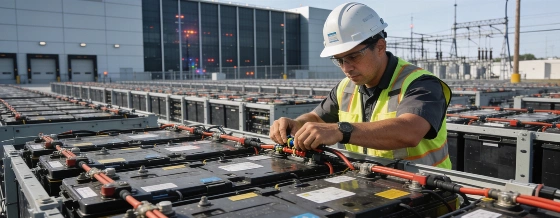
One emerging solution is hiding in plain sight: retired electric vehicle batteries. These battery packs, often removed during warranty replacements or routine maintenance, typically retain about 80% of their original capacity. While no longer suitable for cars, they are well-suited for stationary energy storage at AI data centers. The approach is simple-charge the batteries during off-peak hours when electricity is cheaper, then discharge them when AI workloads spike. This setup acts as a buffer, reducing peak electricity purchases and helping utilities manage demand swings.
“Nobody has a battery farm to supplement the energy demand on their AI data centers yet, because it is too expensive,” said Linda Li, CFO of Re-Teck, a global IT asset disposition and reverse supply chain firm. “Repurposed batteries are the way to break that barrier.”
The scale of the opportunity is significant. Cervicorn Consulting and Market Techie estimate the global data-center battery market will grow from $3.38 billion in 2025 to nearly $6 billion by 2035, fueled by the AI infrastructure surge. Lithium-ion battery shipments for AI data-center storage are projected to jump from 12 gigawatt-hours in 2025 to 272 gigawatt-hours by 2030. Meanwhile, over 17 million electric vehicles were sold worldwide in 2024, creating a growing supply of batteries ready for a second life.
Re-Teck is positioned at the intersection of this trend, receiving retired battery packs from automakers like Tesla, Lucid, and BMW, and providing decommissioning services for major AI data center operators, including Microsoft. Unlike batteries used with renewables, lithium-ion packs are designed for rapid power delivery, making them ideal for AI facilities where demand can spike sharply. Large battery farms built from repurposed EV packs can absorb these fluctuations and ease grid stress.
China already mandates that wind and solar projects include energy storage to balance supply. Re-Teck’s proposal applies a similar model to the demand side: battery farms next to data centers that charge during low demand and discharge during peak periods.
This concept is already being tested. In summer 2025, Redwood Materials, a battery recycling company founded by Tesla co-founder JB Straubel, launched what it called North America’s largest second-life battery storage system at its Sparks, Nevada campus. The 12-megawatt, 63-megawatt-hour microgrid, built from hundreds of repurposed EV battery packs, powers a modular data center run by Crusoe Energy, which houses about 2,000 GPUs and advanced computing systems. Since going live, the project has maintained 99.2% operational availability. Crusoe plans to expand the facility to 24 modular data-center units by early 2026, raising power demand to roughly 20 megawatts.
“Where needed, we incorporate onsite power generation and battery energy storage systems to reduce pressure during peak periods, and we cover the cost of grid infrastructure upgrades to avoid shifting those burdens onto local ratepayers,” wrote Chris Dolan and Jamie McGrath of Crusoe in a blog post.
Despite the promise, challenges remain. Data-center operators invest heavily to guarantee uptime, and any new power component faces intense scrutiny. Repurposed batteries can vary in age, chemistry, and degradation, making performance less predictable than new systems. Safety is also a concern, with thermal runaway risks requiring strict testing, monitoring, and battery-management software. Certification and insurance hurdles must also be addressed before widespread adoption.
Re-Teck is still building the case studies and cost analyses needed to move from pilot projects to contracts. However, economics are shifting. Bloomberg New Energy Finance reported that new lithium-ion battery pack prices for stationary storage dropped to about $70 per kilowatt-hour in 2025, down 45% from the previous year. Repurposed packs sourced directly from automakers can be even more affordable.
The impact of battery reuse goes beyond electricity costs. It also addresses a key vulnerability in the AI race: supply-chain dependence. For example, bismuth-a metal used in electronics and advanced cooling systems-is 90% controlled by China. As AI processors require more sophisticated cooling, supply risks grow. Similar vulnerabilities exist for copper, rare earth elements, and advanced semiconductors. About half of U.S. copper scrap is exported for processing, much of it to China, which also controls 85% of global rare-earth processing capacity. These concentrations create risks for industries reliant on steady access to critical materials.
Domestic recycling of EV batteries, server hardware, and embedded materials is increasingly seen as a national security issue, not just an environmental one. Every battery repurposed instead of dismantled and exported strengthens supply-chain resilience.
There’s a twist of irony: batteries developed to help phase out fossil fuels are now powering the infrastructure behind artificial intelligence. “If you have to buy new batteries to do this, it will never be practical,” said Li of Re-Teck. “Data center operators are drawing energy from the grid 24/7, peak and off-peak. They know that if they have an alternative, like a storage unit, they can supplement peak-hour energy with off-peak energy. But nobody has invested in building this energy storage farm because batteries are too expensive.”
The challenge of powering AI won’t be solved by a single technology. Nuclear, renewables, demand-response, and grid upgrades all have roles to play. But repurposed EV batteries offer a rare combination: a solution available now, scalable with growing waste streams, and able to reduce dependence on fragile supply chains. In the race to power artificial intelligence, that’s a combination worth watching.
Re-Teck, founded in 2000, operates globally with facilities in North America, Europe, and Asia. The company partners with major automakers and technology firms to process and repurpose electronic waste, including EV batteries. As of 2026, Re-Teck has handled millions of devices and battery packs, positioning itself as a key player in the circular economy for electronics and energy storage.