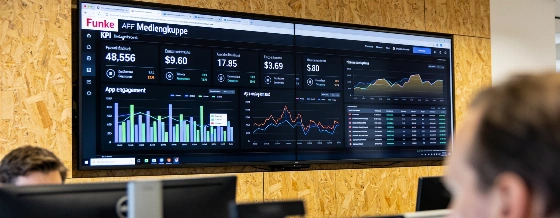
Funke Mediengruppe’s product team developed a KPI tree to guide news app decisions. Their data-led approach aims to align editorial, product, and business goals for better audience retention and revenue.
Funke Mediengruppe has overhauled its approach to product development for its 13 regional news apps, introducing a data-driven framework designed to improve decision-making and audience outcomes. Senior Product Manager Stefan Schneiderbauer, who leads product and development across these brands, shared details of the new system at Audiencers' Festival London in June 2026. The initiative aims to move beyond instinct and opinion, grounding product choices in measurable evidence while supporting editorial judgment.
As news organizations face a landscape where access to information is no longer a unique advantage, Funke’s team focused on building trust through quality journalism and stronger collaboration between editorial and product teams. Schneiderbauer explained that the new framework does not replace editorial insight but provides a structured way to serve audiences more effectively.
Structuring Decisions with a KPI Tree
The foundation of Funke’s new approach is a KPI tree, with 'Engaged Time'-the total time users spend meaningfully interacting with app content-at the top. This metric reflects both user value and commercial potential, as increases in engaged time typically drive ad impressions, subscription conversions, and lower churn.
The KPI tree breaks down Engaged Time into drivers like session length, session frequency, and active user growth. Each branch of the tree identifies ratios and conversion points, such as how many visits lead to downloads or how many active users encounter a paywall. Schneiderbauer noted that focusing on ratios rather than absolutes allows the team to identify more levers for incremental improvement.
By filling the tree with granular data, Funke’s product team can pinpoint 'movable metrics'-specific indicators that can be shifted through targeted product changes. For example, improving homepage content surfacing can increase article click-through rates, which in turn boosts session time and overall engagement.
From Data to Action
Once the KPI tree is populated, the team uses it to model relationships between metrics and conduct sensitivity analyses. This helps identify which variables offer the highest leverage for growth. When a promising metric is found, the team maps out opportunities and solutions, prioritizing those with the greatest potential and feasibility.
One practical outcome was the identification of a retention issue among new users. Data revealed that push notification subscription during onboarding was a key factor in 30-day retention. By running A/B tests to optimize this step, Funke increased push subscribers and saw a measurable rise in engaged time and retention for this segment.
Organizational Alignment
The KPI tree informed the creation of four operational pillars within the product team: Reach (acquiring new users), Engagement (driving habitual use), Monetization (converting engagement into revenue), and Infrastructure (ensuring technical stability and analytics). Each pillar has clear ownership and defined KPIs, but all are interdependent and supported by journalism as the foundation.
To avoid siloed efforts, Funke established cross-pillar meetings where stakeholders from editorial, data, advertising, subscriptions, and tech review shared data and dependencies. This structure ensures that product, editorial, and business teams work from a common set of metrics and priorities.
Strategic Planning and Next Steps
Funke’s framework is now being extended to strategic planning, connecting leading indicators like active users and retention rates to lagging indicators such as revenue. The team envisions future use of AI-driven models to surface high-impact actions automatically, based on the KPI tree’s data structure.
For organizations considering a similar approach, Schneiderbauer recommends starting with a single branch of the KPI tree, instrumenting what is measurable, and building confidence through demonstrated value. He emphasized that the process is iterative, with gaps and incorrect assumptions expected along the way.
Funke’s experience highlights the practical value of a data-led framework for news apps. By making trade-offs visible and aligning teams around shared metrics, the company aims to maximize the impact of its product investments. This approach echoes strategies seen in other media organizations, such as the focus and simplicity that helped The Knowledge grow its subscriber base, as discussed in this analysis of newsletter-driven profitability.