
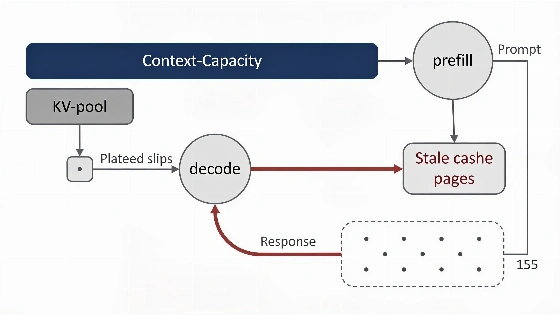
A request too large for GLM-5.3’s prefill cache could still receive an HTTP 200 response. Stale cache pages then exposed data from another customer’s session. Cloudflare’s October 26 incident report says the failure affected 155 responses on Workers AI between August 27 and September 9, 2026; the company found no evidence of deliberate exploitation. In its incident report, Cloudflare said no other Workers AI model was affected.
How the leak worked
Two failures combined. Cloudflare configured GLM 5.3 with a 1,048,576-token context window, while its prefill GPUs had a KV-cache pool sized for 681,280 tokens, a capacity gap of 367,296 tokens. The company knew about the mismatch before launch but expected SGLang to reject prompts the pool could not handle. Long-context tests returned successful responses, yet Cloudflare did not check whether their content was coherent.
The second issue was in SGLang’s disaggregated serving path. When a prompt exceeded the pool, the engine marked it rejected and substituted a one-token placeholder. Prefill still created a cache for that placeholder and signaled completion. The decode node then generated a response using stale cache pages that had held data from earlier requests. The client received HTTP 200 rather than HTTP 400.
GLM runs across separate prefill and decode GPUs: prefill processes the prompt, then transfers its KV cache through Mooncake over remote direct memory access (RDMA). The cache uses shared fixed-size pages that are not zeroed between requests. The engine must track ownership. This disaggregated architecture separates prompt processing from generation and transfers cache data between the two stages, as described in the SGLang deployment guide. The SGLang team says its single-node rejection path returned an error; the exposure occurred only in disaggregated serving.
Response and repair
All 155 affected responses came from prompts longer than 681,280 tokens. Cloudflare said customers received responses containing data from other customers’ requests made shortly beforehand. After excluding its own tests and the researcher’s requests, the identified traffic matched ordinary long-context use in timing and volume. Gadi Evron of Knostic reported the tenant-isolation issue through Cloudflare’s HackerOne program on September 8, 2026. The exposure had begun on August 27, the day GLM 5.3 launched on Workers AI as @cf/zai-org/glm-5.3.
Cloudflare’s Product Security team reproduced the issue with two independent accounts within 25 minutes on September 9. It made the model private at 14:00 UTC, rolled corrected settings to prefill nodes, then rebuilt the deployment with an engine patch before restoring public access at 19:40 UTC. The status page listed the incident as starting at 10:25 AM EDT and resolving at 4:09 PM EDT that day.
The configuration change brought the prefill pool to about 2.04 million tokens, roughly twice the model’s context window. A prompt that fits the window now also fits the pool. The patch makes SGLang stop a rejected request at the admission queue before cache transfer begins. Cloudflare tested both changes against Evron’s reproduction script and its own canary markers.
Upstream safeguards
Cloudflare proposed its fix in SGLang pull request #38704; maintainers merged #38935. A related failure-path fix, #36988, had merged on September 6. The changes shipped in SGLang v0.5.20. Version v0.5.21 followed on October 2, then v0.5.22 on October 19. Cloudflare recommends that SGLang operators update to v0.5.22 or later. The SGLang team says v0.5.21 protects Mooncake and NIXL deployments by default for every failure kind, while MORI deployments need a v0.5.22 build; the fix line was not backported to earlier branches.
SGLang reported that protection-related throughput changes stayed within ±2% across 21 runs on two H100 GPUs, with each 95% confidence interval spanning zero. In a separate 16-run test on two H200 GPUs, enabling deferred KV release by default measured -0.38%, with a confidence interval from -2.12% to +1.36%; the team described the result as not impressive.
Cloudflare advises operators to measure KV pool size against context length on every prefill and decode node after changes to weights or quantization, and after changes to parallelism or memory fraction. It also recommends builds with both admission fixes and deferred KV release on both roles. Workers AI has also hosted Cloudflare’s Clairic preview, a separate model release. For longer-term protection, Cloudflare is working with SGLang on a production version of physical-page checks. Its per-transfer checksum is in pull request #39500.








