
On October 16, 2026, Cloudflare described a system that would continue monitoring verified crawlers after they pass identity checks. The company is building a record of their behavior and plans to publish trust scores on Radar, where customers could set thresholds for Verified bot traffic. In its October 16, 2026 announcement, Cloudflare said correct identification alone does not guarantee responsible conduct.
The customer controls are not live. Cloudflare is still building behavioral histories and refining its assessment. The proposed score would reflect a bot’s conduct over time, rather than the potential harm of one request, and show how consistently it follows site preferences.
Identity is not behavior
Cloudflare’s October 16, 2026 post, “Continuous accountability for Verified bots,” by Chris Tsoukaladelis, separates risk from trust. Risk concerns the possible harm from a particular request; trust reflects a bot’s conduct over time. For publishers, the distinction matters: verification alone does not show whether a crawler will keep following site preferences.
Web Bot Auth uses cryptographic signatures to establish identity. Cloudflare’s BotBase catalogues identities in an open format. The new monitoring system looks at what Verified bots do after admission. Cloudflare says operators should identify themselves accurately and honor their stated commitments without abusive behavior. The company plans to verify a bot’s identity, then reassess whether its observed conduct matches its declarations.
Cloudflare points to its 2025 decision to remove Perplexity’s bot from the Verified list. The company said the bot sought access to sites that had opted out of scraping and tried to circumvent controls after requests were blocked. The new system is meant to track behavior over time, not rely only on one-off decisions such as delisting.
Two behavioral signals
One measure compares a bot’s observed traffic with a site’s robots.txt preferences. Cloudflare says an isolated violation may count for little; repeated disregard is the behavior it wants to catch. The company treats RFC 9309, which formalized the Robots Exclusion Protocol in 2022, as the relevant standard. It also argues that the absence of a prohibition should not automatically count as permission, since a site can object to access through other channels. The standard describes crawler rules. It is not an authorization mechanism or a technical block.
The other signal is how a bot responds to an HTTP 429 “Too Many Requests” response. Defined in RFC 6585, the response tells a visitor to reduce its request rate and may specify how long to wait. Consistent pauses or slowdowns would raise a bot’s trust assessment; repeatedly ignoring the signal would lower it. This measures server load separately from compliance with crawler access rules. Cloudflare says the system will combine observations such as robots.txt compliance and responses to HTTP 429 into an explainable trust range based on behavior over time, not a single request.
That distinction has practical consequences. Wikimedia said OpenAI agents may have contributed to a partial outage of the Wikidata Query Service. Bots accounted for 65% of its most resource-consuming traffic.
From policy to enforcement
Cloudflare describes the monitoring as part of a broader operating process. Bot Preference Sync generates or updates a site’s robots.txt file from the AI crawler policy selected in its dashboard. Bot Management enforces the site’s settings. The trust system then checks whether Verified bots follow the published preferences.
The company introduced Bot Preference Sync in August 2026, alongside plans to block opaque AI crawlers on sites that disallow training. Cloudflare said annual bot submissions had grown roughly seven times since 2023. Reviews of new Verified bot applications had also become automatic. The October announcement adds behavioral checks that continue after approval.
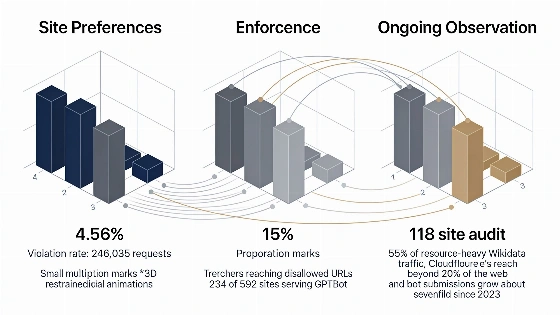
Other services have started measuring robots.txt compliance at individual sites. Microsoft Clarity added violation detection to Bot Analytics in June 2026 and reported an illustrative 4.56% violation rate across 246,035 AI crawler requests. TollBit reported that 15% of AI page fetchers in Europe reached disallowed URLs in the first half of 2026. HasData found that 234 of 592 sites disallowing GPTBot still served it a live page. In a later check, it found no Cloudflare-managed AI block in robots.txt on the 118 sites it examined.
Cloudflare says its network sits in front of more than 20% of the web, giving its proposed system a broader observation base than site-by-site checks. That reach raises a governance question: Cloudflare sells bot management products and decides which operators qualify as Verified. The company calls its assessment explainable and non-permanent, but has not published its criteria or band boundaries. It plans to share scores publicly on Radar and expand the signals it measures as it gathers data.
What remains unknown
Cloudflare has not said how many trust bands it will use or how long it will observe a bot. It has also left unclear how many repeated violations would change its assessment. The company has not identified which Verified bots are under review or whether any have moved down a band, and has not explained how an operator could recover after poor behavior.
Customers will eventually be able to choose a threshold, but Cloudflare has not said what happens when a bot falls below it. Blocking and challenging remain possibilities, as do rate limiting and logging. The company has given no launch date for public Radar scores or customer access.
The change also affects agencies and ad technology vendors that use crawlers for brand-safety checks and ad verification. Others use them for price monitoring or SEO auditing. Some rely on Verified status to reach protected sites, and customer-selected thresholds could reduce the value of that status. As publishers assess changes in AI search and discovery, FAYFO has also covered the shift in AI search.








