
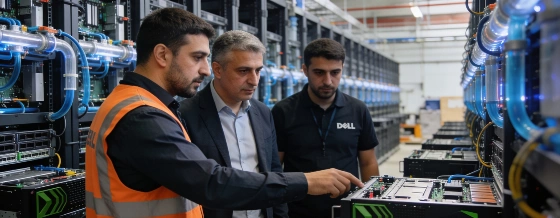
A small nation is investing heavily to become a regional AI compute hub. Armenia’s $500 million Firebird project will host thousands of NVIDIA Blackwell GPUs, aiming to secure sovereign access to advanced AI infrastructure. Political and technical hurdles remain.
Armenia, a country better known for its tech talent than its size or wealth, is making a bold move in the global AI race. Rather than manufacturing chips like Taiwan, Armenia is positioning itself as a regional hub for AI compute power, importing high-end NVIDIA infrastructure and focusing on what officials call “compute sovereignty.”
Recent headlines suggested that NVIDIA was manufacturing chips in Armenia, but the reality is more nuanced. NVIDIA’s Blackwell GPUs are produced using TSMC’s custom 4NP process, keeping chip fabrication outside Armenia. Instead, Armenia’s strategy centers on hosting and operating advanced AI hardware, not building it from scratch.
The centerpiece of this effort is Firebird, a U.S.-based AI cloud and infrastructure company with operations in both San Francisco and Yerevan. According to Armenia’s Ministry of High-Tech Industry, the first phase of the Firebird AI center near Hrazdan is set for 2026, with a $500 million investment, over 6,000 NVIDIA Blackwell GPUs, 18 MW of power, and up to 110.6 exaflops of FP4 Tensor compute. A second phase could bring total investment to $4 billion and add more than 41,000 GPUs, potentially putting Armenia on the global map for AI infrastructure.
Infrastructure, Not Fabrication
The confusion around Armenia’s role is understandable, given the prominence of “chips” in the story. U.S. export approval was required for the NVIDIA hardware, and Dell Technologies is providing server infrastructure. In August 2025, the U.S. and Armenia signed an AI and Semiconductor Innovation Partnership MOU, covering secure semiconductor supply chains, electronics development, and Armenia’s status under U.S. export controls. However, Armenia’s emerging role is focused on AI infrastructure, cloud services, electronics R&D, and engineering talent-not mass chip manufacturing.
NVIDIA now refers to major AI infrastructure as “AI factories”-systems that manufacture intelligence, not physical goods. The GB300 NVL72 platform, for example, combines 72 Blackwell Ultra GPUs and 36 Grace CPUs in a liquid-cooled rack for dense AI training and inference. Dell’s PowerEdge XE9712, used in the project, is designed for high-output AI workloads. Armenia’s initiative is about hosting these systems to enable large-scale AI development.
Regional outlets like Eurasianet reported in November 2025 that U.S. regulators approved the transfer of advanced NVIDIA chips for Armenia’s AI hub, highlighting Dell’s server role and the political significance of the approval. OC Media, citing Bloomberg, noted the project’s 100 MW data center and the importance of export controls, as Armenia had previously faced U.S. restrictions on high-performance AI chip imports.
Strategic Drive for Compute Power
Armenia’s motivation is clear: the country has a strong base in software engineering, mathematics, and electronic design, with companies like Synopsys Armenia employing over 1,000 people in R&D and product support. While not a chip-manufacturing powerhouse, Armenia is deeply connected to the semiconductor value chain.
The Firebird project aims to fill a critical gap-massive compute capacity. Without local access to advanced GPUs, Armenian talent and startups must rely on foreign cloud providers, limiting research and innovation. “Compute sovereignty” captures Armenia’s goal: ensuring national access to AI infrastructure as a development priority, much like broadband or energy grids.
There’s also a public-sector angle. Armenia has partnered with Mistral AI to develop AI assistants and public services tailored to local needs, focusing on adaptable models for Armenian language and infrastructure. This approach connects infrastructure, government, startups, universities, and international partners in a broader AI ecosystem.
Challenges Ahead
Building an “AI factory” at this scale brings major challenges. A 100 MW data center consumes as much electricity as a city of 120,000 people, and requires robust cooling. Armenia’s Ministry of High-Tech Industry says the Firebird center will use a closed-loop water-cooling system needing infrequent water changes. Armenia’s current electricity generation-nuclear, hydro, and thermal-can support rising demand, according to the U.S. International Trade Administration.
Execution risks remain. Firebird is a young company, and the leap from announcement to a fully operational, commercially viable AI hub is significant. The project needs customers, reliable power, cooling, network resilience, stable export controls, and a local ecosystem to absorb compute capacity. Team Telecom Armenia is installing next-generation fiber-optic infrastructure with up to 1 Tbps bandwidth. OC Media reports that some compute will be allocated to domestic firms, with the rest sold to U.S.-based companies in the region. The allocation and pricing of GPU access will determine how much local benefit Armenia gains.
Ultimately, Armenia’s AI push is not about making chips, but about transforming imported hardware into strategic national capacity. If Firebird, Dell, NVIDIA, U.S. export approvals, and local investments align, Armenia could become a unique case of a small, landlocked nation using AI infrastructure as a development strategy. This approach echoes the way other industries are being reshaped by new technologies, as seen when creators on Etsy faced disruption from AI-generated art and drop-shipping.
Firebird, the company at the heart of Armenia’s AI infrastructure ambitions, was founded in the United States and operates between San Francisco and Yerevan. As of 2026, Firebird has announced plans for a $500 million initial investment in Armenia, with a second phase potentially raising total investment to $4 billion. The company’s partnership with NVIDIA and Dell, along with U.S. export approvals, positions it as a key player in the region’s emerging AI ecosystem. Firebird’s success will depend on its ability to deliver large-scale compute, attract customers, and integrate with Armenia’s growing tech sector.