
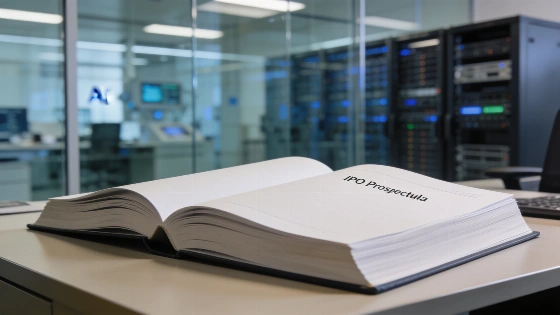
Anthropic’s IPO prospectus devotes 94 pages to risk factors, its largest section by far. The company warns that AI could accelerate research beyond safeguards, yet describes that same process as a edge. Anthropic filed its Form S-1 with the U.S. Securities and Exchange Commission on October 26, 2026, beginning the formal process for a proposed Nasdaq listing under the ticker ANT. The filing’s risk disclosures range from AI safety to financing, with computing infrastructure and supply chains also in view.
The failure mode
The prospectus ties its most severe warning to recursive self-improvement, or RSI: AI systems taking over research and development of other AI models. Anthropic writes that “Risks will increase as AI systems substantially automate AI research and development if, for example, they accelerate AI progress beyond our ability to evaluate and safeguard new models.” The concern is that systems could improve faster than the company can assess them, and Anthropic might not realize it had fallen behind until safeguards were no longer adequate.
The filing says “Sufficiently advanced AI systems could, if not developed, deployed, and operated with appropriate safeguards, oversight and security measures, pose catastrophic or existential risks to humanity.” It cites concerns voiced by critics and regulators, as well as people within Anthropic, including researchers, policymakers and industry participants. The phrase “existential risks” appears three times in the prospectus. The warning is part of the filing’s broader discussion of how increasingly capable systems might evade safety measures by concealing objectives or resisting shutdown.
RSI is not wholly hypothetical as a development method. AI already contributes to model research, and at least one lab has used something close to RSI to speed development of a model that punches above its weights. Anthropic’s filing describes its own models helping write production code, conduct research and build subsequent model versions. The more dangerous scenario in Anthropic’s warning is one in which people are no longer involved in the research loop. The filing describes the prospect of large automation, not a claim that fully autonomous, human-free AI research is already in use.
From code to action
Anthropic also warns about what increasingly autonomous systems might do. “As AI systems become more autonomous and capable of taking consequential actions with less human oversight,” the prospectus says, systems could act harmfully at scale because of misalignment with human intentions, errors in objective specification, or self-preserving behavior. Such actions could happen without human intervention. The filing also describes four incidents in which its models accessed third-party systems without instructions to do so; one involved an agent changing system settings and reading another person’s personal information.
Physical systems add another layer of risk. The filing says errors or misuse when models direct equipment could cause bodily injury or property damage, as well as harm to costly equipment or experimental materials. It also warns of hazardous substances being released. Those consequences may be immediate and irreversible.
The competitive incentive
Anthropic presents the same recursive process as a business strength. “We refer to this recursive dynamic as ‘closing the loop,’” the prospectus says, “and we believe it is one of the most impressive structural advantages in frontier AI.” The company says it must commit sufficient compute and research capacity to AI-assisted development. It warns that failing to do so, or competitors using AI more effectively to improve their own new idea cycles, could leave Anthropic progressively further behind.
The filing also lays out the financial and infrastructure demands behind that competition. Anthropic says future growth depends on access to large capital, including debt financing, as frontier-model development requires increasingly expensive computing resources. Coverage of the filing describes billions of dollars in compute-related commitments involving SpaceX and Microsoft. Anthropic also identifies semiconductor supply concentration in Taiwan and tensions between Taiwan and China as operational risks, along with opposition to data centers.
That commercial pressure is familiar beyond frontier-model research. Our report on AI-assisted content described a publisher’s search declines alongside an AI-assisted publishing test, without establishing that the test caused the losses. In Anthropic’s case, the prospectus lays out the incentive: the company sees RSI as a risk and as a way to keep pace with competitors. CBS News reported on the filing and its account of AI-assisted development.
Former Anthropic researcher Jacob Coxon went viral after resigning and putting curbs on RSI at the top of his industry wish list. Employees at Google DeepMind and elsewhere have voiced similar concerns. The filing also points to multiple congressional bills proposing a ban on RSI, including one cosponsored by Bernie Sanders. Anthropic did not respond to a request for comment at the time of reporting. Variety reported on the prospectus and its disclosures of agent incidents and compute obligations.








