As the United States marks 250 years, leaders warn that AI and misinformation threaten the future of journalism and democracy. Public media faces funding cuts and rising challenges to trust. Here’s what’s at stake.
With the 250th anniversary of American independence approaching, the nation is reflecting on its revolutionary roots and the new challenges facing democracy. In Boston, a city central to the original revolution, the conversation has shifted from historic battles to the digital frontlines of innovation and information.
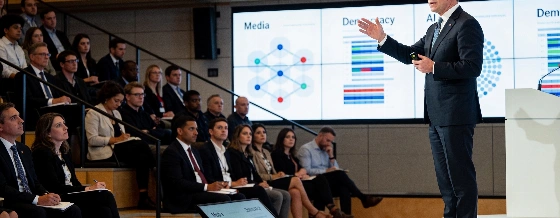
This year, Susan Goldberg, CEO of GBH, the country’s leading public media organization based in Boston, addressed these issues in a keynote speech ahead of July 4. Goldberg highlighted the existential questions posed by artificial intelligence, emphasizing that the current revolution is unfolding not in the streets, but in digital spaces, boardrooms, research labs, and universities. She described the rise of AI as a force that compels society to examine its values and the very nature of humanity.
Goldberg’s remarks came at a time when public media is bracing for a projected $1.1 billion loss in federal funding during 2025-2026. She called the coming year “topsy-turvy” for public broadcasters, but noted that advocacy efforts are underway to address the shortfall. “We’re starting to regain our financial footing, we’re reinventing our revenue streams, and we’re continuing to enhance our journalism,” Goldberg said. She stressed the importance of investigative reporting, especially as news deserts expand and local journalism becomes more fragile.
Goldberg warned that a “blizzard of misinformation” is undermining public trust and destabilizing institutions. She cited the rise of “thumb on the scale journalism,” newsroom closures driven by billionaire owners, and the erosion of faith in scientific research. “Some people don’t believe in anything anymore,” she said, underscoring the urgency of protecting the First Amendment and the role of a free press in sustaining democracy. “These are essential for a functioning democracy. This is something we must choose to keep, or it might slip away.”
She also pointed to the dangers of “government by falsehood” and “algorithmic chaos,” which cloud public discourse and make it harder for citizens to discern truth. Goldberg called for radical transparency, locally sourced reporting, and a culture that acknowledges mistakes rather than distorting reality. “Telling stories can change the world,” she said, describing the mission of GBH and other public media organizations to illuminate problems and highlight solutions for audiences of all backgrounds.
Goldberg concluded by reaffirming the commitment of public media to serve diverse communities, from digital natives to those less comfortable with technology. “We’ll be battling on behalf of our audiences,” she said, “who want to make their country a better place.”
Forbes originally reported this story.
GBH, formerly known as WGBH, is one of the largest public media organizations in the United States. Headquartered in Boston, it produces national programming for PBS and NPR, reaching millions of viewers and listeners each week. According to its 2025 annual report, GBH operates with a staff of over 800 employees and an annual budget exceeding $200 million, making it a key player in the nation’s public broadcasting landscape.