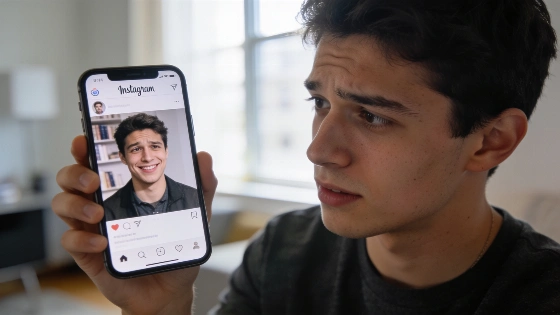
social media users have recently seen a wave of seemingly friendly male influencers promoting Goose, a dating and friendship app for gay men. Accounts such as @miles.sumrall and @danielmmulugeta, both created in May 2026, have shared personalized invite codes and messages through Close Friends Stories and direct messages. Their posts feature cheerful avatars and identical captions inviting recipients to join Goose’s “members only community.”
Investigations using AI Image Detector software and Google Gemini’s SynthID tool found that the profile photos for these accounts are almost certainly AI-generated. Both @miles.sumrall and @danielmmulugeta were flagged as having images created with Google AI, with confidence levels exceeding 90 percent. The accounts have few posts and unusually high following-to-follower ratios, common signs of inauthentic profiles. The results require a technical distinction: a confidence score from image-detection software is not interchangeable with a SynthID result. Publicly available since October 2026, Google DeepMind’s SynthID Detector checks uploaded media for compatible watermarks, including images and audio or video files. It is not designed to identify every AI-generated image. Google describes it as “not a general AI detector” and says a result showing “no confident signal” does not establish that media is authentic. Its coverage includes Google’s tools and participating partners such as OpenAI; NVIDIA and Kakao are also covered. Meta and Microsoft use systems the detector does not read. Cropping or other edits can weaken a watermark. SynthID so provides provenance evidence, not proof of who created or operated an Instagram account. Google’s description of the detector is detailed in InfoQ’s report on SynthID.
Goose, co-founded by model-influencer Derek Chadwick and former BeReal growth manager David Aliagas, presents itself as a relationship-focused alternative to Grindr. Amid initial skepticism, one X user joked, “Goose is basically Pokémon Ho.” The app quickly climbed to #4 in the App Store’s free lifestyle downloads after launching last Thursday and now ranks 33rd globally in the lifestyle category. The surge in downloads appears linked to promotion by these AI-driven influencer accounts.
WIRED identified more than two dozen similar social media profiles, all created in May or June 2026, with sparse content and frequent cross-commenting using heart and fire emojis. These accounts often follow potential users, add them to Close Friends Stories, or send direct messages with identical invitations to join Goose. Marketing professionals Ryan Cheam and Dalton Bauer said they received multiple, nearly identical DMs from new accounts such as @alistaircrombbie and @lucalepkowski. Their profile images also tested as AI-generated or AI-edited. Repeated captions, account-creation dates and cross-commenting point to a coordinated promotional pattern, but do not identify who operated the profiles or establish that Goose commissioned the activity.
Goose cofounder David Aliagas has posted social media Stories advertising paid “ambassador” roles managing multiple social media accounts. The jobs offer $1,800 to $2,100 per month for several hours of daily work. He also mentioned buying “finstas” (fake social media accounts) for $100 each. The recruitment posts remain visible in his Story highlights under “AMBASSADORS.”
Undisclosed marketing with AI-generated influencers is not unique to Goose. A recent Guardian investigation cited a former celebrity manager who estimated that 40 to 60 percent of some major brands’ influencer content is artificially generated, often without disclosure. Advertising attorney Rob Freund and other legal experts say the US Federal Trade Commission prohibits deceptive advertising, including fake accounts used to simulate real users. New York law now requires advertisers to disclose AI-generated content, with fines starting at $1,000 for violations.
Meta, which owns social media, requires users to label artificially generated content and may remove posts that fail to comply. social media’s labeling structure distinguishes between disclosures on individual posts and an account-level label for profiles centered on an AI-generated person. The labels are not interchangeable. The platform may use industry signals, including C2PA and IPTC metadata, alongside creator disclosures, to label some AI-generated or edited content. A missing label alone does not establish that an account is authentic. Yet private DMs and Close Friends Stories complicate enforcement. Many users may not realize that the influencers promoting Goose are not real people. Some, including Cheam, have raised concerns about the campaign’s deceptive tactics and called for greater transparency.