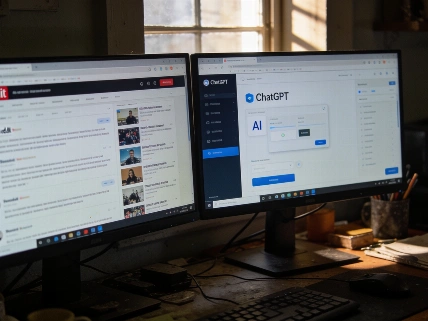

AI-generated content is raising new questions about authorship. Detection tools offer clues but not certainty. Editorial judgment and verification remain essential.
As generative AI tools become more common in newsrooms and content operations, questions about who actually creates digital content are intensifying. Publishers, editors, and content creators now face growing uncertainty over whether a text, image, or video was produced by a human or an algorithm. According to a Reuters Institute analysis, current AI detection tools can provide useful signals but cannot deliver definitive proof of authorship. This limitation has direct implications for editorial standards, audience trust, and even professional reputations.
The report highlights that AI detectors, such as Pangram, analyze linguistic patterns and return probabilities about a text’s origin. While Pangram claims up to 99.98% accuracy in some tests, the Reuters Institute notes that even the most advanced systems operate on probabilities, not certainties. In practice, this means editors and audiences cannot rely solely on these tools to enforce policies or resolve disputes over AI-generated content.
Problems escalate when detection tools are used to judge individual cases. In one adversarial test cited by the Reuters Institute, Alexios Mantzarlis of Indicator found that Pangram misclassified AI-generated texts as human-written in 86% of cases designed to exploit its weaknesses. The risk is not just technical error but the potential for personal consequences, such as job loss, academic penalties, or public accusations based on flawed evidence.
Some newsrooms have adopted guidelines for AI use, but enforcement remains difficult. Even in organizations that ban AI-generated articles, it is challenging for editors to confirm compliance. Common markers of synthetic writing-like repetitive structures or predictable phrasing-can also appear in human-authored work, further blurring the line.
Alternative approaches are emerging. Voluntary human authorship certification, such as the system offered by ProudlyHuman, involves identity checks, author declarations, AI detection, and human review. If a work cannot be verified as human-made, ProudlyHuman simply withholds certification rather than making accusations. Other initiatives, including No AI Movement and Books by People, offer similar labels, but the proliferation of different standards and audit levels can confuse audiences about what each certification actually guarantees.
Content provenance systems represent a third strategy, especially for images, video, and audio. The Content Credentials system, backed by the Coalition for Content Provenance and Authenticity (C2PA)-which includes Adobe, Amazon, BBC, Google, Meta, Microsoft, and OpenAI-attaches cryptographic metadata to files, recording details like creator, device, capture time, and edits. However, these credentials only appear when supported by participating devices or platforms, are still rare online, and can be lost through certain uploads or screenshots. Provenance can help trace a file’s journey but does not guarantee its truthfulness or prevent misleading use out of context.
The Reuters Institute concludes that while AI detectors, human authorship certifications, and provenance systems can all provide valuable signals, none can replace editorial judgment or thorough verification. No tool currently offers a simple yes-or-no answer to the question of authorship. As generative AI becomes more integrated into content workflows, the focus is shifting from merely detecting machine involvement to building transparent processes that help evaluate the origin, creation, and reliability of digital content.
These challenges echo concerns raised in other parts of the media industry, such as skepticism over new AI reporting tools on platforms like LinkedIn, which some creators fear could be misused or misunderstood. For example, a recent report on LinkedIn’s AI content flagging feature highlighted similar risks of reputational harm and confusion over what constitutes AI-generated material.