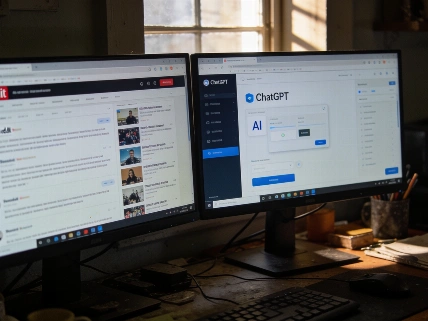

Fewer users are clicking through to publisher sites after receiving AI-generated answers. New research shows most find these responses sufficient, raising concerns for media traffic and revenue.
Media and publishing professionals face a growing challenge as AI-generated answers increasingly satisfy user queries, reducing the need to visit original publisher sites. According to new findings from the AOP’s 'Artificial Intelligence Publisher Impact Study', a significant portion of UK internet users now accept AI responses as 'good enough,' which is impacting referral traffic and publisher revenue.
The study, conducted by Ipsos, highlights a shift in user behavior driven by AI platforms. When an AI Overview appears in Google Search results, users are 18% less likely to click through to the original source. On standalone platforms like ChatGPT, only 26% of users say they would click at least one media link in a response, compared to 34% for Google Search with AI Overview and 37% for Google’s AI Mode.
This 'stop here' behavior takes two forms: some users end their search after receiving a satisfactory answer, while others continue with follow-up queries within the AI platform itself. Both patterns keep users within the AI environment and away from publisher content, limiting opportunities for traffic and monetization.
ChatGPT’s conversational design encourages ongoing engagement, with twice as many users making follow-up queries within the interface compared to Google’s AI Mode. While Google’s AI features appear to drive some users off-platform, ChatGPT is structured to retain users, potentially deepening publisher challenges as AI adoption grows.
Demographic data from the study shows that AI usage is highest among males, degree-holders, and those aged 25 to 34. Nearly half of users aged 18 to 34 report using ChatGPT more than once a week, while only 11% of those 55 and older do the same. Google Search remains widely used across all age groups, peaking among 45-54-year-olds.
Interestingly, the 25-35-year-old cohort-most likely to use AI-are also the most likely to click on links for further information, with 20% saying they 'definitely would need to click on a media/news link.' In contrast, only 8% of users aged 55+ report the same intent, and just 15% of those aged 18 to 24 feel the need to click through.
Frequent AI users are more likely to complete their information journey within the platform. About a quarter of those using Google’s AI Mode monthly stop at the AI answer, rising to nearly 40% among daily users-higher than ChatGPT’s rate. The study also found that trust in the source affects click-through rates: about a third of users do not click through if they either completely distrust or completely trust the source, as trust in the publisher brand can make the AI-generated answer feel sufficient.
This dynamic creates a Catch-22 for premium media brands: their credibility makes AI answers more valuable, but also reduces the incentive for users to visit their sites. However, the study suggests that if users lose trust in AI-generated information, convenience alone may not keep them on the platform.
Publishers are exploring solutions to these challenges. For example, some are adopting tools to monitor and correct AI-generated misinformation, as seen in efforts like Profound’s FactCheck, which helps brands address inaccuracies in AI search results (see how brands are responding to AI misinformation).