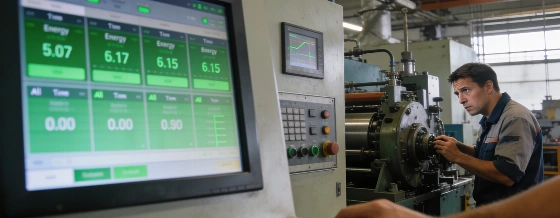
Many factories rely on real-time dashboards to track energy and carbon, but these systems often overlook slow-developing issues. This blind spot can lead to hidden costs and emissions that go undetected for weeks.
For years, manufacturers have been urged to move beyond monthly energy and carbon reports and instead monitor these metrics in real time, directly within production systems. That advice still stands, but a recent stress test of this approach revealed a critical flaw: the most common monitoring setups are excellent at catching sudden failures, yet they routinely miss gradual, slow-building faults.
When tested against thousands of simulated fault scenarios, the real-time monitoring model quickly flagged abrupt problems like compressed-air leaks, pump breakdowns, or machines left running overnight. These incidents triggered alerts within minutes, pinpointing the source and allowing for swift intervention. However, when faults developed slowly-such as a tool wearing down over a shift or an auxiliary system degrading incrementally-the system often failed to detect them at all.
This oversight isn’t due to poor sensor quality or simplistic algorithms. Instead, it stems from how most monitoring systems define “normal.” By relying on a rolling recent average, these systems gradually absorb slow changes into their baseline, effectively learning to ignore the very faults that can drive up costs and emissions over time. As a result, dashboards may remain reassuringly green even as efficiency quietly erodes.
The danger lies in the false sense of security this creates. If a monitoring system missed every problem, users would remain skeptical. But when it reliably catches dramatic failures while missing subtle, long-term issues, it can foster misplaced confidence in system health. Leaders may see alerts working for obvious events and assume the system is comprehensive, unaware of the hidden gaps.
Another key finding: many factories still use utility-grade meters that record data every 15 minutes or so. This low-resolution data is too coarse for real-time anomaly detection, making it impossible to distinguish genuine problems from normal fluctuations. No amount of advanced alerting can compensate for insufficient measurement frequency, and vendor demos using high-resolution data may not reveal this limitation.
It’s important to note that these insights come from a simulation based on real machine data and engineering literature, not from live factory deployments. The next step is to validate these findings with actual industrial data.
So, what should manufacturers do? Real-time monitoring remains valuable for catching fast-moving, high-impact problems. But to address its blind spots, two strategies are recommended. First, instead of comparing current performance to a moving average, anchor “normal” to specific, known-good moments-such as after a tool change or maintenance reset. This makes it easier to spot gradual drifts. Second, supplement monitoring by comparing a machine’s actual energy use to the expected consumption for its current job. Any slow divergence between these values can reveal hidden inefficiencies, regardless of how gradually they develop. Both methods are well-established and typically require no new technology-just a shift in how existing data is used.
Ultimately, manufacturers should recognize that a green dashboard does not guarantee a healthy operation. The most valuable insight a monitoring system can provide is an honest account of what it cannot detect. Most systems aren’t offering that transparency, making it crucial for leaders to understand and address these blind spots themselves.