
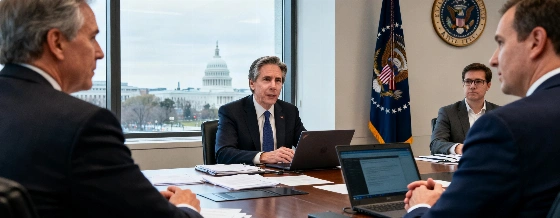
US officials and Anthropic are negotiating new rules for AI model security. Recent export controls halted access to Anthropic’s latest models. Talks now focus on setting benchmarks for government oversight.
The White House and Anthropic are in advanced talks to create a standardized framework for evaluating security flaws in cutting-edge AI models, according to senior administration sources. This initiative follows the Biden administration’s decision to impose export controls on Anthropic, which led the company to suspend global access to its latest AI models, Fable 5 and Mythos 5, after officials flagged a vulnerability known as a jailbreak.
Disagreements between Anthropic CEO Dario Amodei and government officials over the seriousness of the jailbreak highlighted the lack of clear criteria for assessing such incidents. The rapid evolution of AI technology has outpaced existing government mechanisms for defining and resolving these disputes, prompting urgent efforts to establish new guardrails for the sector.
The ongoing negotiations, led for Anthropic by head of public policy Sarah Heck and cofounder Tom Brown, aim to develop a set of technical benchmarks for future incidents. These would measure the extent to which model safeguards are bypassed, the capabilities exposed, and the real-world consequences of any breach. Both Anthropic and the White House declined to comment on the record.
While the export controls remain in place, the shift toward technical standards signals progress in the talks. Last Friday, discussions stalled after Anthropic refused to de-deploy Fable, arguing the vulnerability was minor and did not constitute a significant security risk. In response, the White House barred foreign users from accessing the model, forcing Anthropic to withdraw it from the market.
Over the weekend, senior administration officials and Anthropic leaders, including Tom Brown, Commerce Secretary Howard Lutnick, and National Cyber Director Sean Cairncross, held a series of lengthy calls. These discussions led to nearly a week of in-person meetings in Washington, with Anthropic sending senior researchers and safeguards experts to the Commerce Department to address concerns.
The push for a common evaluation framework reflects a broader recognition-echoed by other AI companies and G7 leaders in France-that no AI model is completely immune to hacking. The government’s goal is to set clear rules for how companies should measure and report security risks, ensuring a consistent approach as more powerful models emerge.
For those interested in the balance between innovation and accountability in AI, a related discussion on the importance of deterministic systems in regulated industries can be found in this analysis of traceability and reproducibility in generative AI.
This story was originally reported by POLITICO and is part of the Axel Springer Global Reporters Network, which brings together journalists from outlets including POLITICO and Business Insider to cover major international developments.
Founded in 2021, Anthropic has quickly become a major player in the AI sector, raising over $7 billion in funding and employing more than 400 people as of 2026. The company’s Claude models are widely used in enterprise and research settings, and Anthropic’s rapid growth has drawn significant regulatory attention in both the US and abroad.