
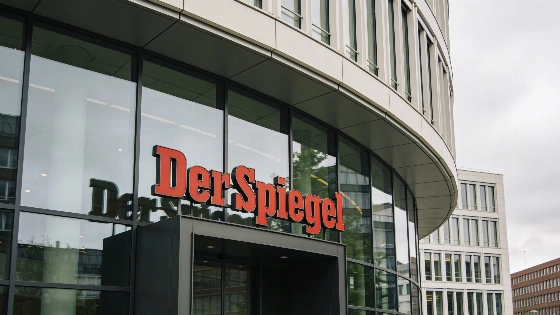
Der Spiegel is shifting its reporting strategy to give constructive journalism a stronger focus. The publisher has introduced a new label, 'Spiegel Solutions,' designed to highlight where progress is being made in politics and society while maintaining its established investigative standards.
Information from the company, all editorial departments will now be encouraged to look beyond crises and conflicts and report on successful initiatives and effective solutions. The move follows internal discussions about whether a persistent focus on negative news contributes to public pessimism. The editorial team said the new approach will sit alongside its critical coverage, with the magazine remaining committed to the principle of 'Sagen, was ist': reporting both positive and negative realities.
That distinction is basic to constructive journalism as described by Ellen Heinrichs, founder and chief executive of the Bonn Institute. In remarks reported by The Media Online, Heinrichs said the approach examines “potential solutions, multiple perspectives and constructive dialogue without ignoring corruption, political failures or uncomfortable truths.” She has also argued that journalism should help audiences understand “what can be done about those problems.” The model asks journalists to scrutinize possible responses while continuing to report failures and hold decision-makers accountable.
Editor-in-chief Dirk Kurbjuweit said constructive journalism is not intended to dilute critical reporting. He described the initiative as a way to encourage democratic debate that leads to solutions instead of simply highlighting disagreements. Kurbjuweit previously led a visual redesign of 'Der Spiegel' in late summer, also seen as a signal of change within the industry.
The first new format under the 'Spiegel Solutions' banner is 'Spiegel-Mediation,' which updates the traditional debate format by focusing on finding common ground between opposing viewpoints. In its debut, climate activist Luisa Neubauer and CDU politician Sepp Müller discuss climate protection, aiming to identify shared interests despite their differences. Author Susanne Beyer developed the concept after exploring journalistic responses to polarization during a fellowship at the Thomas-Mann-House in Los Angeles. Beyer has outlined her ideas in a recent 'Spiegel' essay.
The initiative arrives amid wider concerns about news fatigue and trust. A comparative survey published by the Jean-Jaurès Foundation found that, among four countries examined, Germany had the lowest reported news-fatigue level: 39% said they felt fatigued and 38% reported stress from information overload. Germany recorded the highest media-trust level in the comparison, at 68%; 77% of respondents said reliable information was easy to identify, and 85% felt able to inform themselves using digital tools. The findings also showed political differences within Germany: distrust in the media was reported by 44% of respondents on the far right and 20% on the left, while 13% of right-wing respondents and 22% of left-wing respondents said they felt well represented. The figures show why national averages alone may not capture how different audiences experience news.
News avoidance is also a concern beyond Germany. A report citing the Reuters Institute’s Digital News Report said 42% of surveyed South African online audiences sometimes or often avoided the news, while trust in news among that audience fell from 61% in 2022 to 50% in 2026. Against that backdrop, the Bonn Institute’s structure puts audience relevance and dialogue alongside scrutiny, without treating solutions coverage as a substitute for critical reporting.
The publisher sees 'Spiegel Solutions' as more than a new format. Its message is that critical journalism and constructive perspectives can coexist. The approach is expected to appeal to readers, as well as advertisers and marketers seeking media environments that audiences view positively and consider credible and socially relevant. Related industry discussions have also highlighted the importance of editorial depth and context in engaging audiences, including recent coverage of live blog strategies.








