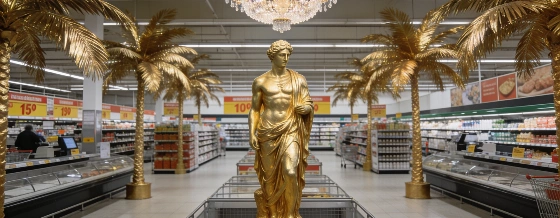
A Frankfurt Penny store will become a branded space inspired by Leyla Heiter. The project blends retail and influencer marketing in a new way. Shoppers will step into a physical extension of a creator’s brand.
Retailers are pushing the boundaries of influencer partnerships, and Penny is taking a bold step by turning an entire Frankfurt store into a branded environment inspired by Leyla Heiter. For content and publishing professionals, this move signals a shift in how physical retail spaces can drive both foot traffic and social media engagement by leveraging creator brands.
Starting July 30, visitors to the Penny location in Frankfurt-Praunheim will find more than just groceries. The store will feature gold palm trees, chandeliers, and a life-sized statue, all designed to immerse shoppers in the world of Leyla Heiter, known from reality TV. Penny clarified that this is not a franchise or a standalone market, but a co-designed store operated as part of its regular network. Heiter described the project as her personal “Kim-K-Moment,” while the retailer aims to create an experience more akin to a pop-up from a global lifestyle brand than a traditional discount store.
This collaboration marks a new phase in influencer marketing. Instead of simply promoting products or launching creator brands, the physical store itself becomes a marketing platform. The result is a walk-in social media set, blurring the line between shopping and entertainment.
Penny and its agency Saint Elmo's have already found success with social-first formats like “Gerüchteküche.” Other German retailers have also experimented with influencer partnerships: Aldi Nord has built a YouTube and social presence with We are Era, Rewe has teamed up with food influencers for product launches, and Lidl has run campaigns with creators and reality stars. Kaufland’s influencer collaborations have sometimes sparked controversy, as seen with Michael Wendler, but the company has remained open to experimentation. Edeka has used influencers for seasonal campaigns, though until now, the focus has been on products rather than transforming entire stores. The most notable early example remains Bianca Heinicke’s 2016 “Bilou” launch with DM, which drove both in-store visits and social media activity.
The benefits for retailers are clear: influencers bring loyal audiences who identify more with personalities than with retail brands, generating reach, buzz, and increased store visits. As customer loyalty declines, emotional experiences can outweigh price as a driver. However, critics warn that turning stores into event spaces can blur the line between shopping and spectacle, and retailers risk reputational fallout if an influencer faces public backlash. The experience of Kaufland with Michael Wendler is a reminder of these risks.
With “Leylaland,” Penny is testing how far traditional retail can evolve into an experiential environment. The true measure of success will be whether the initiative delivers sustained increases in store traffic and emotional brand engagement, not just headlines. The partnership between retailers and influencers is entering a new era, with the supermarket itself becoming a stage for creator-driven experiences.
Other brands are also exploring new ways to connect with audiences through creators. For example, Mastercard recently launched a social series featuring creators visiting local restaurants, aiming to boost small business visibility and network reach. More details on this approach can be found in this report on Mastercard’s creator-driven campaigns.