
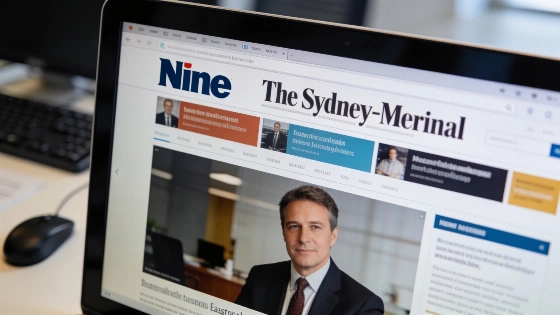
Microsoft has reached an agreement with Nine, Australia’s largest locally owned media company, to license journalism from its mastheads for Microsoft Copilot’s AI search results. Signed on 3 July 2026, the arrangement covers The Australian Financial Review, The Sydney Morning Herald, The Age and Brisbane Times. Microsoft described it as its first deal of this kind in the Asia-Pacific region.
Copilot will use Nine journalism in real time to generate AI answers, showing headlines, snippets and summaries alongside links to publishers’ websites. Microsoft said the feature would “direct audiences” to the news brands’ websites for the full story. Press Gazette reported that the agreement is intended to ground Copilot responses in Nine content. It licenses those outputs; it does not transfer Nine’s copyrights or publicly grant unrestricted rights to train foundation models on its archives.
Nine chief executive Matt Stanton called the partnership a way to ground AI-generated outputs in verified, premium journalism and stressed the importance of copyright protection and intellectual-property value. Microsoft Australia and New Zealand president Jane Livesey said the agreement showed how technology and media companies could work together to support journalism and give users confidence in information provided by Copilot. Nine managing director of publishing Tory Maguire said the deal opens revenue opportunities for the company’s mastheads and supports the evolution of local journalism.
The commercial terms have not been disclosed. Nine has presented the deal as a new revenue chance, but its payment formula, duration and usage limits remain unknown. The agreement also leaves unresolved the wider question of whether and how copyrighted material may be used to train AI models: real-time retrieval to ground an answer is distinct from using works to train a model.
That distinction sits at the center of Australia’s copyright debate. In October 2025, the government ruled out a text-and-data-mining exception for AI developers, leaving the issue to existing copyright rules and licensing arrangements. In July 2026, Prime Minister Anthony Albanese said at the University of Sydney: “No company should use Australian books, music, art or news to build or train AI without the artist’s control.”
Technology companies and creator groups have taken opposing positions in the parliamentary inquiry into AI. Anthropic special envoy Jeffrey Bleich argued that licensing every rights holder across the internet was impractical, saying “it is impossible to license the entire internet.” Authors’ and illustrators’ organizations, by contrast, have called for consent, transparency about training data and fair payment. Louise Stark, representing Hachette Australia, called on companies to disclose which works they used to train models and to license future uses on terms that fairly compensate creators.
In October 2026, inquiry chair Jo Briskey and deputy chair Jonathan Duniam recommended that Australia “examine current copyright settings” while ensuring creators retain control and are paid. The proposed review followed testimony from technology companies, authors, musicians and other rights holders. It is a recommendation, not a change to the law. The International Confederation of Music Publishers has also opposed weakening copyright protections. Its director general, John Phelan, accused technology companies of trying to “strong-arm” Australia over copyright. The organization has also raised claims about AI training on artists’ work without compensation. Those disputes concern training and model outputs, not the separate Microsoft-Nine licensing agreement.
Nine Entertainment Co. reported revenue of more than AUD 2.7 billion in its most recent fiscal year, information from company filings, and operates several of Australia’s major news brands. Microsoft Copilot, launched in 2023, has expanded its use of licensed news content as AI-powered search tools gain prominence. The Nine agreement adds a negotiated licensing and attribution model to that changing field, while the broader debate over AI training and copyright remains unresolved.








