
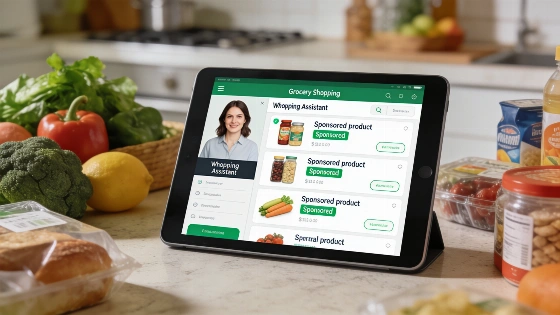
Kroger Precision Marketing has introduced product listing ads as sponsored placements within Kroger’s AI-powered shopping assistant. The update gives advertisers a way to reach shoppers as they build lists or seek meal inspiration, with sponsored items appearing alongside organic results in the assistant’s interface. Kroger describes the assistant as a tool for meal planning and product discovery, while helping shoppers find value through the websites and apps of the Kroger Family of Companies.
The new ad placements are clearly marked as sponsored content and are available across the family’s digital platforms. When users interact with the assistant, for example by asking for snack ideas or recipes, relevant product listing ads from active Search & Browse PLA campaigns may appear. Advertisers running this campaign type are included without additional setup or bidding adjustments, extending existing campaigns into another shopping environment.
Advertisers can use Kroger Precision Marketing’s report builder to analyze Shopping Assistant product listing ads separately from other inventory. That reporting gives brands a way to assess how sponsored placements perform within AI-assisted shopping, where product discovery and grocery planning take place in the same interface.
The assistant also expands the commercial role of Kroger’s first-party digital environment, which includes online stores and loyalty accounts, with transaction data underpinning both. During Kroger’s June earnings call, CEO Greg Foran highlighted that 95% of the company’s transactions are linked to a loyalty card, supported by more than two decades of purchase history. He described Kroger Precision Marketing as a high-margin business built on first-party data, emphasizing its ability to help advertisers measure purchase behavior rather than intent. Foran also said data is becoming the most valuable currency in advertising.
Kroger Precision Marketing’s retail media network has been estimated to generate less than $5 million in annual revenue, while serving as a growing business stream for its parent company. Kroger’s broader “alternative profit businesses,” a category that includes retail media and data analytics, generated about $1.5 billion in operating profit in the fiscal year ended January 31, 2026, information from figures cited from the company’s annual report. That total describes the wider category, not KPM alone. Kroger also reported that KPM profit grew by more than 20% year over year in the first quarter of fiscal 2026. The company’s annual reports and investor materials provide broader context for its digital and data businesses.
The expansion fits into Kroger’s wider digital-growth strategy. In its October 2026 financial structure, the company tied growth in e-commerce to increased retail-media revenue, including further development of Kroger Precision Marketing. Kroger set a target of approximately 3% comparable-sales growth in 2029, excluding fuel and pharmacy, and projected adjusted EBITDA compound annual growth of 3% to 6% and adjusted net-earnings-per-share compound annual growth of 7% to 11% for fiscal 2027 through fiscal 2029. Those targets exclude the pending Giant Eagle acquisition and describe Kroger’s planned standalone trajectory. The company said it aims to “grow eCommerce sales and Retail Media revenue” while accelerating growth in Kroger Precision Marketing.
This move follows a broader trend of retailers and platforms expanding direct ad opportunities for brands. For example, a recent collaboration between PubMatic and Zynga has enabled advertisers to reach mobile gamers more directly through new in-game ad pathways.
Founded in 1883, Kroger is one of the largest grocery retailers in the United States, operating nearly 2,800 stores across the country. The company has invested in digital commerce and retail media, using its loyalty program and first-party data to support targeted advertising and new revenue streams. Launched in 2017, Kroger Precision Marketing continues to expand its offerings as brands seek measurable ways to connect with shoppers online.








