A 4-foot-tall robot named Edward Warchocki is captivating Poland and social media, sparking debate over the future of affordable humanoid robots. Unitree’s G1 model is now a global sensation, but regulatory hurdles loom.
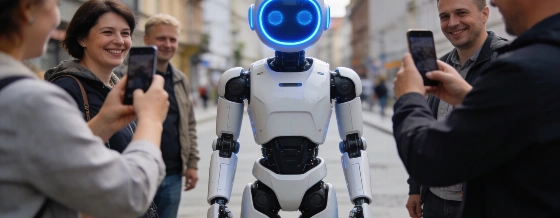
When Edward Warchocki strolls through Polish streets, he draws crowds not just for his childlike stature but for his surprisingly relatable personality. Created by Bartosz Idzik and Radosław Grzelaczyk, Edward is a 4-foot-tall humanoid robot powered by a large language model, capable of holding live conversations in Polish. Initially, Edward’s silent presence unsettled passersby, but once he began speaking, he quickly became a local celebrity. He’s visited parliament, hiked mountains, and even starred in a viral video chasing wild boars in Warsaw-complete with a backpack and a Rolex. Today, Edward boasts over 1 million followers and 4 billion views across social platforms.
Edward is just one of many humanoid robots making waves worldwide. In 2026, robots like “Rizzbot” in Austin, “Bart Robot” in New York, and Miami’s “Brickell Clanker” have become social media fixtures, often without viewers realizing they all share the same hardware: the Unitree G1. Manufactured by China’s Unitree, the G1 is a compact, aluminum-limbed robot with a glowing blue ring for a face. It’s appeared on America’s Got Talent, performed kung fu, danced at concerts, and even been ordained as a monk in Asia. Unitree’s recent financial filings reveal the company shipped 5,511 humanoid robots in 2025, with an average price under $25,000, and 43% of sales coming from outside China. The company turned a profit for the first time last year, signaling a shift from lab prototypes to real-world adoption.
Jake Cooperstein, a 24-year-old in Miami, was inspired by Edward’s rise and decided to purchase his own Unitree G1. After testing the robot in New York, he opted for the U5 educational variant, paying $66,000 for enhanced customization. His “Brickell Clanker” became a hit at World Cup after-parties, donning different jerseys and entertaining crowds. Cooperstein now rents out the robot for events, charging $800 to $1,200 per hour. He recently acquired a Unitree R1, a lighter, more affordable model, but future purchases are uncertain. In July, the US Federal Communications Commission banned new Chinese-made humanoid robots, leaving the fate of upcoming Unitree models in the US market unclear. Unitree did not respond to requests for comment.
In Europe, Edward Warchocki faces fewer regulatory obstacles. Idzik’s company, MERA Robotics, now operates a fleet of 20 humanoid robots-mostly Unitree G1s-across Poland, the Middle East, and Southeast Asia. While the robots’ conversational abilities are powered by advanced language models, their physical movements remain largely teleoperated due to safety concerns. The G1 comes preloaded with about 20 gestures and 15 dance moves, but programming new actions requires technical skill. Cooperstein recalls the excitement when Brickell Clanker debuted at a World Cup fan festival, blending seamlessly into the crowd as he controlled it remotely. “It feels like the future,” he says.
As humanoid robots become more visible in public life, questions remain about their practical roles beyond entertainment and social media. While some see them as the next step in automation, others wonder when these machines will transition from viral stunts to meaningful economic contributions. The debate echoes broader concerns about AI’s impact on work and society, a topic explored in depth in our coverage of how AI tools are transforming business security.
Founded in Hangzhou, China, Unitree Robotics has rapidly expanded its global footprint since launching the G1 model. The company’s focus on affordability and real-world usability has set it apart from competitors, with over 5,500 humanoid robots shipped in 2025 alone. As Unitree prepares for its public listing on the Chinese stock market, its ability to navigate international regulations and sustain profitability will be closely watched by both investors and the robotics industry.