
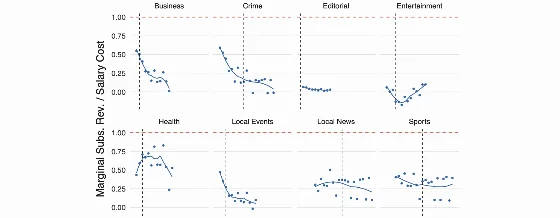
Local newsrooms hoping to boost digital subscriptions should focus on hard news. Politics and public health stories convert readers better than entertainment. Yet, even these high-value articles rarely cover their own costs. The business model remains fragile.
For anyone building a business around local news, the latest research delivers a wake-up call. The stories that actually convince readers to pay for digital subscriptions aren’t the viral entertainment pieces or lifestyle columns. Instead, it’s the hard-hitting coverage—local government, public health, and politics—that nudges casual visitors to become paying supporters. These are the stories that matter most for civic life, and they’re the ones that move the needle on subscriptions.
But here’s the catch: even the most valuable journalism doesn’t generate enough digital revenue to pay for itself. A sweeping analysis of over 1.2 billion user sessions and 600 million article visits, tracked over four years, reveals a sobering reality. While readers flock to entertainment and sports for quick hits, they’re far more likely to open their wallets for in-depth reporting on issues that shape their communities. Yet, the conversion rate remains too low to sustain newsroom costs.
Researchers followed individual user journeys, mapping which articles drew attention and which moments at the paywall led to a subscription. The data upends the old assumption that only entertainment drives engagement. In fact, willingness to pay is a different beast from willingness to click. Newsrooms chasing pageviews alone are missing the bigger picture: the stories that drive subscriptions aren’t always the ones that rack up the most traffic.
Still, the economics are tough. Even if a publisher hires another reporter to double down on hard news, the extra digital subscriptions generated won’t come close to covering that journalist’s salary. At best, a new local news reporter might bring in enough to pay for a quarter of their own compensation. Even during the pandemic, when public health reporting was in high demand, the numbers only improved modestly.
Other revenue streams—print and digital ads—aren’t picking up the slack. The direct link between a reporter’s work and the bottom line is more abstract than ever. In a world where digital subscriptions are the main hope for sustainability, the math just doesn’t add up. Newsrooms face a dilemma: lean into the journalism that matters most, knowing it won’t pay the bills, or chase traffic with softer stories that rarely convert loyal subscribers.
Gregory J. Martin, the lead researcher from Stanford University, and his team used market-average salaries to estimate the financial impact. Their findings suggest that, for now, even the most strategic editorial investments can’t guarantee financial stability. The study’s granular approach offers rare insight into the real-world economics of digital news, challenging publishers to rethink what success looks like in the subscription era.
Stanford’s Gregory J. Martin has become a key voice in the evolving conversation about local news sustainability. His research stands out for its unprecedented scale and detail, tracking millions of user interactions to reveal what truly drives digital subscriptions. By connecting individual reporters, specific stories, and actual subscription decisions, Martin’s work offers a data-driven roadmap for publishers navigating the digital transition. As newsrooms face ongoing cuts and shifting business models, his findings are shaping how industry leaders think about the future of local journalism.