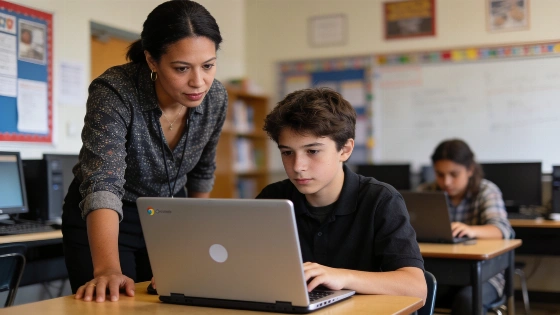
Google’s new student-account controls arrive as the company puts its school reach at around 50 million Chromebooks and more than 150 million Google Classroom users worldwide. On November 3, 2026, Google announced that Gemini, Gemini Notebook, Gemini in Classroom and Google Search would be off by default for K-12 student accounts until school administrators explicitly enable them. Administrators will be able to enable or disable the services individually, including Search independently of Gemini products. But Search will not have a conventional mode without AI Overviews or AI Mode: schools cannot keep it on while turning off those embedded features.
That leaves districts seeking to shield students from AI-generated summaries with a blunt option: disable Google Search for student accounts. Schools that leave the services off will show students a notice that Search is unavailable, rather than providing a non-AI version. For schools built around Chromebooks and Google Classroom, moving to another search engine takes more than changing an individual setting.
Google vice president and general manager of education Chris Phillips said in a blog post that access to Gemini, Gemini Notebook, Gemini in Classroom and Google Search “will be entirely off for K-12 student accounts until school administrators explicitly turn them on.” Phillips told The New York Times that “Search and AI are deeply integrated,” adding that students at schools that do not opt in “will not have access to search, and they’ll see a message from their school that indicates it’s not available,” as TechCrunch reported.
Google framed the controls as giving schools “more choice, not less” in a post on X, pointing to the ability to enable services one at a time. The company also described Guided Learning, which coaches students through problems with questions and step-by-step support rather than supplying an answer immediately. Google said the feature was available worldwide in Google Classroom; a Search version was due to begin a pilot in selected U.S. schools later in November 2026. For participating student accounts, Google described both a consumer-style Search experience with AI Overviews and AI chats, and a Guided Learning mode intended for students.
Schools had already asked Google for that missing control. About two weeks before Google’s announcement, an IT administrator at an elementary-middle school asked on the company’s support forums for a way to block AI Overviews, WIRED reported. The administrator wrote: “Students need opportunities to navigate search results, examine sources, and draw their own conclusions rather than being handed an AI-generated synthesis before they’ve even started.” WIRED said nobody from Google replied.
Accuracy is part of the concern. A Washington University in St. Louis study cited by WIRED found that only about 42 percent of AI Overviews could be fully verified from their citations. Google says the summaries undergo rigorous testing and keep improving. Nicole Kerson, a former senior Google Search product manager, told WIRED that maintaining a separate version without AI Overviews would be difficult: “It’s a question of whether they’re committed to maintaining two versions of search in the long run,” she said. “It’s very hard to maintain a forked product like that.”
Some alternatives already exist. Microsoft offers a Chrome extension that turns off AI-generated summaries in Bing. Fairfax County Public Schools in Virginia built a browser extension, while other districts rewrite search addresses; those workarounds may stop working when Google changes how it delivers results. A separate Google Search workaround describes a long-standing option for clearing AI Overviews and other results-page clutter, though it does not add the school-level control educators requested.
DuckDuckGo, which offers a version of its search engine with AI answers turned off, pointed schools to instructions for changing their default search engine. Its chief public affairs officer, Kamyl Bazbaz, wrote on X: “Forcing AI on school children: how a monopolist behaves when they think people are powerless. Prove Google wrong.” The new defaults are expected to begin rolling out in early 2027. Google has not set a rollout date; its post said it would share specifics with schools “in the coming months ahead of the changes rolling out.”