
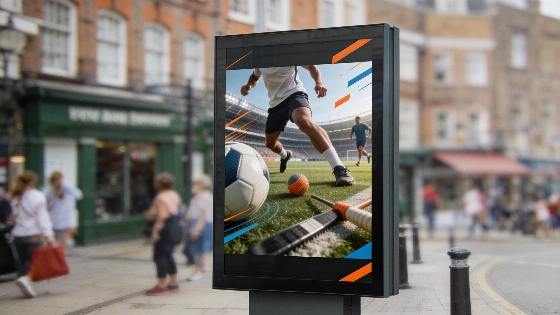
Publishers and advertisers are paying more attention to women’s sports as audience engagement rises; technology vendors are also responding to new advertising opportunities. With streaming TV ad budgets shifting toward sports, digital out-of-home (DOOH) advertising is becoming a basic channel for brands aiming to reach fans where they gather. Nielsen reported that women’s sports generated 46 billion minutes viewed in 2025, up 71% from 2022, and reached an estimated 122.5 million U.S. fans. Advertising spending in the category rose 120% over the same period, strengthening the commercial case for brands seeking sports audiences across screens and in physical venues.
That growth sits within a broader expansion of the women’s sports business. Deloitte projections summarized by Shelley Zalis in Forbes coverage of Deloitte’s projections put global women’s elite-sports revenue at about $3 billion in 2026, up from $2.4 billion in 2025. Commercial income, including sponsorships and merchandise, is expected to make up roughly 45% of the total, alongside broadcast and matchday revenue. Nielsen also reported that more than 30% of NWSL fans had purchased from a brand after seeing an in-game sponsorship, showing how sports exposure can prompt consumer action.
One example is the Women’s Sports Index, developed by Deep Blue and Mondo Metrics, which gives brands data on engagement trends and purchase intent across creator partnerships. The platform is designed to provide marketers with actionable insights for campaigns targeting women’s sports audiences. Brands increasingly look beyond viewing figures: sponsorship response can reveal whether exposure translates into purchase behavior.
Associate Editor Victoria McNally said women’s sports fans often behave differently from men’s sports fans. Citing a recent Vox Media survey, McNally noted that men’s sports fans are more likely to support teams because of family tradition, while women’s sports fans tend to be motivated by a genuine passion for the game. She also observed that women’s sports audiences are more likely to build communities around individual athletes, making their fandom more active and community-driven. Nielsen’s findings add a commercial dimension: 60% of women’s-sports fans said they had switched brands because of a company’s values.
Audience growth, but, does not mean every fan follows a league or attends games frequently. An Associated Press-NORC poll cited in coverage found that roughly three in 10 U.S. adults followed women’s professional or college sports, compared with about half who followed men’s sports. Women’s-sports followers were also more likely to describe their viewing or attendance as occasional. For marketers, that distinction makes placement and timing impressive: a large potential audience can coexist with varying levels of habitual engagement.
DOOH advertising is also gaining momentum. Following the conclusion of the 2026 FIFA World Cup, Sweetgreen partnered with Atmosphere TV to run targeted ads in sports bars during the tournament. Atmosphere TV prefers to be identified as a connected TV (CTV) platform rather than DOOH, but its strategy focuses on delivering relevant ads near physical retail locations to lead foot traffic. This approach is particularly valuable for food chains seeking more in-store visits.
Other brands are using digital billboards for high-visibility campaigns. Eyewear company Blacksheep recently used digital displays to criticize Google for allegedly diverting search traffic away from its website. Meanwhile, HelloFresh launched AI-generated creative on digital billboards in Times Square, illustrating the growing role of technology in out-of-home advertising.
These developments reflect a broader shift in how brands and publishers approach sports marketing. Fan behavior is changing, with younger audiences showing interest in athlete stories and creator-driven content. For example, recent research on Gen Z sports fans shows a preference for athlete narratives and fan-created content over traditional team loyalty, further shaping marketing strategies in the sports sector.








