
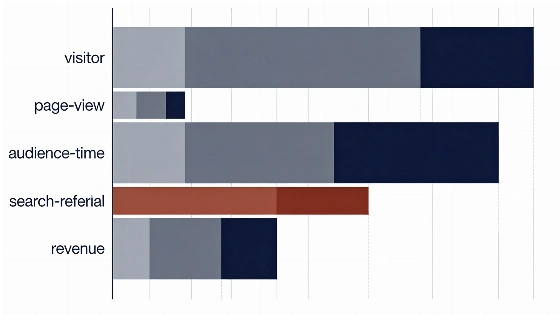
Page views across the surveyed publisher sites fell 18% from 2023 to 2025, while time spent dropped 11%, information from Digital Content Next. The trade group told a court that unique visitors to the sample of member sites fell 26% over the same period, while supporting publishers suing OpenAI and Microsoft. DCN submitted the audience data in 2026 as part of the consolidated copyright proceedings in the U.S. District Court for the Southern District of New York.
Traffic evidence
DCN’s filing argues that AI tools are contributing to the declines. The figures describe changes across a survey sample; they do not establish that AI alone caused the losses. The filing says advertising revenue and total revenue for DCN members each fell 5% in 2025, after beginning what DCN called a “downward trajectory.” It adds: “RAG is thus already eating away at publishers’ businesses.” The figures and DCN’s account of the filing were reported by Press Gazette.
The filing points to changes in search and AI products. Google began rolling out AI summaries at the top of search results in May 2024, and ChatGPT arrived in November 2023. The companies, along with Microsoft, train AI tools on publisher material and continue scraping content to retrieve current information through retrieval-augmented generation, or RAG. They have signed some content deals with publishers, while maintaining that scraping does not require permission because it qualifies as “fair use.”
DCN also pointed to referral data from a survey of 19 member companies, including major newsrooms and global entertainment brands. Google search referrals to those publishers fell 10% on average in May and June 2025 compared with the same period in 2024. In a repeat survey covering the same eight-week period in 2026, the average year-over-year drop was 22%. DCN said the surveys measured referral performance during comparable eight-week periods.
AI and audience loss
A study published in 2026 by researchers affiliated with Carnegie Mellon University and the Indian School of Business found that Google AI Overviews “reduce outbound organic clicks to publishers’ webpages by 39.8%,” according to DCN’s filing. The randomized field experiment involved 1,065 U.S. desktop Chrome users, with the reported reduction concentrated in informational searches. Researchers found no measurable difference in bounce rates or quick exits. Time spent on destination sites also showed no measurable difference between users who saw AI Overviews and those who did not. The filing says ChatGPT and Microsoft Copilot (formerly Bing Chat) “almost certainly have a similar effect.” A separate AI Overviews analysis examined how summaries can expand without a user click; it described browsing data showing lower traditional-link click rates on visits with summaries, while noting that the data did not test automatic expansion.
Advertising represented 84% of revenue for the DCN members surveyed in 2025; subscriptions and other sources accounted for the remaining 16%. DCN argues that traffic losses threaten those other revenue streams too. It cited a 2025 survey of New York Times subscribers in which 36% of respondents who used or paid for ChatGPT for news agreed that the tool “means I no longer need news from the New York Times at all.”
The filing also cites testimony from an executive at another newspaper, who said subscribers were “cancelling” because publishers were “competing with a zero price on ChatGPT, on Copilot.” DCN argued that each subscriber lost to a substitute AI tool removes a recurring source of funding for new work.
Copyright dispute
DCN contends that the platforms’ use of publisher material does not qualify as fair use because their AI products have negative effects on the digital publishing market. The Open Markets Institute made a related argument in its own amicus brief, saying fair use should not apply when AI products substitute for original reporting and weaken its creation. The News/Media Alliance, whose members include plaintiffs in the case, told the court that copyright protection helps news organizations recover the costs of reporting. The Association of American Publishers, the International Association of Scientific, Technical & Medical Publishers, the Independent Book Publishers Association and the Copyright Clearance Center also filed an amicus brief supporting plaintiffs in the consolidated litigation, describing the allegations as involving the use of copyrighted works to train commercial AI models.
OpenAI and Microsoft have argued that training AI models on copyrighted material can qualify as fair use. Microsoft has also cited expert analysis that Copilot rarely reproduces full sentences from news material used to ground its answers, arguing that this “hardly undermines the transformative purpose of LLM training.” These are the companies’ litigation positions; the dispute remains before the court. The publishers’ trade groups’ amicus brief announcement set out their support for the plaintiffs.
DCN warned that RAG relies on access to high-quality material while the products built with that material may reduce publishers’ ability to produce it. The organization described the resulting risk as a “doom loop,” a term it said Microsoft has also used. DCN’s filing further accused the defendants of “wholesale piracy of original content”; that is the trade group’s allegation, not a court finding.
The New York Times and other publishers, including The New York Daily News and Ziff Davis, have asked for summary judgment in their favor to avoid a trial. OpenAI and Microsoft have also sought summary judgment. The New York Times is a DCN member, alongside The Washington Post, News Corp, Advance Local, Conde Nast, Financial Times, Fox News and The Guardian.








