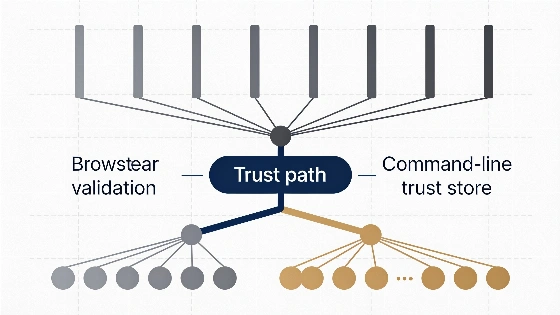
MacOS curl still accepted the compromised certificate chain after Apple blocked it. That matters because browser protections do not necessarily cover software that checks certificates through its own trust store. The incident began on 17 October 2026, when an independent researcher identified as Wayne notified Apple, Google, Microsoft, Mozilla and eMudhra.
The trust-store gap
Eight eMudhra intermediate certificates used weak private keys, making it possible to forge a certificate for any domain. An attacker could use one to impersonate a server and intercept or modify traffic. No stolen key was needed: the key values were below 256 and could be recalculated almost instantly. Wayne demonstrated control of the eight keys by signing a short test message without publishing the private keys; Mozilla’s Bugzilla record confirmed that the proof of key control was valid.
Cloudflare says customers may need to act themselves. Its warning applies to operators of origin servers, mutual transport layer security (TLS) deployments and containers, where separate trust settings can remain in use after browser makers block a certificate. The weakness affected eMudhra intermediate certificates in emSign chains, including paths cross-signed through AAA Certificate Services.
The keys were generated during an April 2025 key ceremony. eMudhra told Mozilla’s bug tracker that a code flaw during an approved test produced a second, weaker set of keys, which were used by mistake. The India-based company is the country’s largest licensed certification authority and sells website certificates under the emSign brand. It revoked all eight affected intermediates and stopped issuing certificates through the impacted infrastructure.
Browsers and beyond
Firefox and Chrome blocked the certificates starting 17 October; Apple devices followed on 19 October, and Microsoft applied its block on 20 October. Chrome’s CRLSet blocked six certificates used to issue web certificates by 19:45 UTC on 17 October. Firefox added the same six to OneCRL by 22:59 UTC that day. Mozilla began its blocking process about three hours after Wayne’s notification, using a mechanism that did not require a full browser release. Cloudflare learned of the compromise at about 17:00 UTC on 19 October and said it prioritized patches for critical services before public disclosure. It found no active exploitation on its services.
Cloudflare published updates for its WARP and 1.1.1.1 domain name system (DNS) clients on 20 October, along with an update for its Tunnel software. It said content delivery network (CDN) and server-side Zero Trust mitigations were complete by 19:20 UTC on 19 October.
Those fixes do not automatically reach customer-managed systems. Mutual TLS users should review which certificate authorities they trust to verify client certificates. Container operators should inspect images for affected trust stores, update CA bundles and libraries, rebuild images and restart services. A host update does not refresh a trust store embedded in an older container image.
Checks can differ
Updating a software development kit (SDK) may not resolve the problem. An application programming interface (API) client can delegate certificate checks to an HTTP library. It may instead rely on a language runtime, the operating system or a custom configuration. Cloudflare cautioned that a browser passing a test does not show that a background service is protected; a curl test may also miss a problem in an application using a different verifier.
Mozilla’s Dennis Jackson published emudhra.we-have-a-problem.com to check whether a browser still trusts the compromised intermediates. The site also explains how to test command-line tools and links to a crowdsourced list of patched software packages.
iTnews found that macOS curl still accepted the compromised chain despite Apple’s block. Curl checks certificates against its own file, /etc/ssl/cert.pem, without consulting revocation information. Jackson’s suggested workaround is to remove two root certificates from that file: eMudhra’s emSign ECC Root CA - G3 and Sectigo’s AAA Certificate Services, which cross-signed the weak keys.
Root trust changes
Cloudflare warned that patching can break systems and urged customers not to take the shortcut of disabling certificate checks. “It’s important to not resolve these errors by disabling verification,” the company said.
Browser makers can use fast revocation mechanisms such as Chrome’s CRLSet to block certificates quickly. Operators may have hundreds of applications to update. Cloudflare backed projects such as Canonical’s upki, which treats trust stores as something that needs rapid updates rather than a static list of root authorities.
Mozilla is removing trust in eMudhra’s emSign ECC Root CA - G3 entirely, and Google has committed to a similar move. The root could appear in certificate paths through different cross-signing chains, including AAA Certificate Services, so blocking intermediate certificates does not automatically remove trust in the root from every application or independent trust store. eMudhra said it had stopped issuing certificates from all intermediates under that root and estimated that about 30,000 certificates needed to be migrated.