
Cloudflare mitigated 18.2 million network-layer DDoS attacks from July through September, along with 14.4 trillion malicious HTTP requests. The network-layer total was up 208% from the same quarter of 2025, information from Cloudflare’s Q3 report. That works out to more than 8,200 attacks per hour, but the largest bursts became less common.
Fewer massive bursts
Cloudflare counted 251 “hypervolumetric” attacks above 1 Tbps in Q3 2026, down from 805 in Q2. That is a decline of nearly 69%. Q2’s figure followed a sixfold increase from Q1. The drop coincided with a March international operation targeting command-and-control infrastructure associated with four major IoT botnets: Aisuru, KimWolf, JackSkid and Mossad. On March 19, the U.S. Department of Justice joined the court-authorized operation; the DOJ said more than three million devices worldwide had been hijacked. Authorities in Canada and Germany also acted against people allegedly connected to the botnets. Cloudflare says the timing may reflect the law-enforcement actions, but does not establish that they caused the decline.
Aisuru had previously powered a record-setting 31.4 Tbps attack. German police said Aisuru and KimWolf each comprised millions of infected devices. Those included routers and webcams, as well as Android TV boxes. The compromised-device networks could be used for DDoS-for-hire activity, including through services known as booters.
The threat remains. Cloudflare identified newer IoT-botnet variants Dysphoria and Evooo1Bot after the disruption. Mirai-classified traffic reached 57.23 petabytes in August, the heaviest month of the quarter for that category. The longest Mirai attack recorded during Q3 began on August 19 and lasted 49.7 hours.
Small attacks dominate
The overwhelming majority of the quarter’s attacks were brief and low-volume: 96% ended within ten minutes, while 98% stayed below 1 Gbps. Cloudflare notes that even a sub-gigabit attack can overwhelm an unprotected website. The company describes the pattern as typical of DDoS-for-hire services known as “booters,” which let customers purchase temporary traffic floods rather than operate their own botnets.
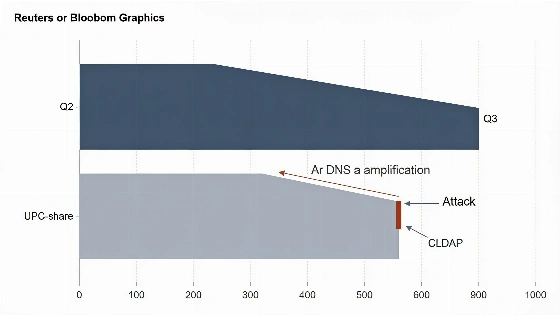
Attack methods are changing, too. CLDAP attacks had risen 580% in the first half of the year, but Cloudflare recorded a 99.5% decline and says they now make up 0.05% of all attacks. DNS amplification rose 215%. UDP floods also gained share, climbing from 14% to 31% of attacks.
Targets shift
The United States replaced China as the most-attacked country in Cloudflare’s network-layer ranking. Canada moved from 16th place to sixth, while Israel climbed seven spots to 10th. Media remained the most-attacked sector, though its share fell to one-quarter of its Q2 level. The rankings reflect activity observed or mitigated across Cloudflare’s network.
Cloudflare says its network capacity is 500 Tbps across more than 330 cities. More than 800 networks use its free DDoS Botnet Threat Feed. The company’s broader security footprint also includes API abuse: a separate credential phishing incident involved keys used to send messages from official domains.








