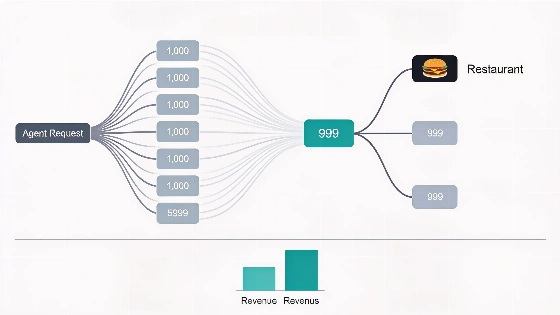
An AI agent choosing a Manhattan restaurant could visit 1,000 restaurant websites before a user picks one, Cloudflare CEO Matthew Prince said on the company’s November 5 earnings call. He said charging agents for that activity could eventually become Cloudflare’s largest business: “if you look 10 years out, I would imagine that this becomes the largest part of Cloudflare’s business.”
The example captures the commercial problem Prince described: sites pay to serve visits that may bring them no customer. Of the 1,000 restaurants an agent might examine, he said, 999 bear a cost without a benefit. Agent activity can far outstrip a person browsing a few options. As Prince put it, “we are going to have to figure out some additional way to pay for it.” Both quotes appear in The Motley Fool’s transcript of the call.
Two charging models
One path is to make crawling less wasteful. Cloudflare can tell crawlers when a page changes, reducing repeat visits to pages with no new information. Prince said OpenAI is paying for the service. It can give OpenAI fresher data while cutting wasted resources for Cloudflare customers.
The other idea is a micropayment when an agent visits a page. Prince said an agent that explains its purpose could pay less. An agent searching for a family vacation, for example, might be allowed onto a travel site free, leaving the site a chance to earn through advertising. Cloudflare had also introduced Cloudflare Wallets and cloudflare.pay, tools that give agents an identity handle and let them pay for services from a stablecoin balance. Prince did not say when per-visit payments might become a significant revenue source.
The distinction matters for publishers: paid crawling is a service Prince said Cloudflare already sells to OpenAI, while micropayments remain a proposed model. Cloudflare did not disclose agent-related revenue in the call excerpts or its earnings release.
Revenue and limits
Cloudflare reported third-quarter revenue of $782.5 million, up 39% year over year, in its November 5 earnings release. The company credited growth to its Workers Developer Platform and agentic workloads across its network, with large-customer momentum and sales execution also contributing. Adjusted earnings per share were $0.38, compared with $0.27 a year earlier, and adjusted operating margin was 17.5%. Cloudflare forecast fourth-quarter revenue of $845 million to $846 million, and raised its full-year 2026 revenue outlook to approximately $2.963 billion to $2.964 billion. The fourth-quarter guidance midpoint is 8.1% above third-quarter revenue, based on our calculation. The company did not break out how much of its reported revenue came from agent-related services.
Cloudflare added a record 158,000 paying customers in the third quarter, nearly twice its previous quarterly record, according to the earnings-call transcript. Management linked much of the increase to developers using the company’s platform.
Prince also argued that container-based systems used by hyperscalers and neoclouds cannot run new agent workloads cost-effectively. He said Cloudflare uses isolates, but gave no cost comparison in the earnings-call excerpts. A separate September 12 clip posted by Fireside Alpha contains his claim that running one agent in a container for every knowledge worker would require 40 times the number of CPUs produced worldwide. That figure was not part of the November 5 call.
On the call, Prince revisited an earlier prediction that agents would outnumber humans online by 1,000 to 1 within five years. He said he would now “take the under on the timing of that bet.” A similar distinction between evidence and inference appears in FAYFO Media’s SEO automation coverage: visibility gains coincided with platform use, but the investigation did not establish causation.