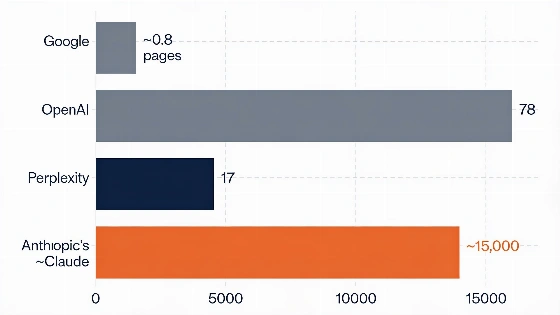
From Sept. 5 to Oct. 4, 2026, a mid-sized European publisher served 58.9 million pages, with fewer than half going to people. AI systems opened 4 million pages through 33 agents and sent back 7,418 traceable visits. That is one visit for every 540 pages read, according to an analysis by HoneyLog, a server-side log intelligence platform.
What the logs show
The gap varies sharply by company. Google’s crawler read 1.2 million pages and sent back nearly 1.5 million visits. OpenAI read about 78 pages for every reader it sent; Perplexity read about 117. Anthropic’s Claude read roughly 15,000 pages per reader. These are figures from one European publisher, not a measurement of South African sites. Search referrals and chatbot referrals are counted through different mechanisms, so their ratios are not directly interchangeable.
The distinction matters because Google Analytics measures activity in a reader’s browser, generally relying on client-side code to run and send an event, while AI bots usually do not run the JavaScript that records those visits. A server log captures HTTP requests reaching a site, whether they come from a person or a bot. Robots.txt rules, caching, JavaScript rendering, identity spoofing, rate limits and content-delivery-network architecture can also affect the counts. A separate report on OpenAI’s publisher dashboard described a platform-side view of mentions and website clicks; server logs measure requests reaching the publisher’s own site.
South Africa’s visibility gap
That measurement problem sits alongside a major unresolved licensing question. In November 2025, Google and YouTube committed R688-million to South Africa’s news industry following the Competition Commission’s Media and Digital Platforms Market Inquiry. The commission had estimated that Google extracted R300-million to R500-million a year in value from South African publishers. The figures are not directly comparable, but the agreement established that platforms benefiting from local journalism should contribute to its sustainability.
The commission also found that AI chatbots had scraped South African news without agreement or compensation, while AI companies showed little interest in content deals with local publishers. A September 2026 study of 263 South African news websites by the Media Leadership Think Tank at Gibs and partners found that 30.4% used robots.txt to block at least one AI crawler, up from 29.7% in December 2025.
The traffic numbers show a difficult tradeoff. Leading local news sites lost about a fifth of their daily page views between May 2025 and May 2026. Competition Commission figures show AI chatbots referred less than 1% of their visits to news sites from January through May 2025. AI search can help people find journalism, but the available referral figure is small.
Different bots, different choices
Server logs can separate crawler behavior that a single “bot” category would blur. Search engine crawlers index pages and send readers back. AI training scrapers copy content to train models, with no visits returned; on the HoneyLog client site, they made about 935,000 requests in a month.
AI indexing crawlers made 2.8 million requests to index content for chatbot answers, which may include a source link. Citation agents fetch a page in real time after a person asks about it in a chat. Blocking those requests can remove a publisher’s material from the answers users see.
Impersonation adds another complication: bots posing as something else, including fake Googlebots, made up 10.4% of all requests. Some 93% of those requests came from data centers, and 83% were served pages as normal. Robots.txt does not control them.
Evidence for licensing
When licensing talks begin, publishers with server-side records can show which AI companies accessed which articles and whether those requests sent readers back. The logs can also distinguish training scrapers from crawlers that fetch pages for answers, giving publishers a basis to assess use and audit a license.
HoneyLog says its platform reads server and content delivery network logs to identify requests from readers, crawlers, scrapers and impersonators. It is part of the same group as Publytics. Anna Battistella, HoneyLog and Publytics’ communications and marketing lead, authored the material, which was paid for by the party concerned.