
The report’s answer panel exposed a useful distinction: a page retrieved by an AI system is not necessarily cited in its response. One stored ChatGPT answer, dated October 9, named Airalo and Holafly but left out Saily.
Ahrefs Brand Radar lets researchers open that response and inspect its source pages. That is a better starting point than treating an AI visibility score as a verdict.
In a comparison of Saily with Airalo and Holafly, the tool helped trace a gap from a broad platform report to a specific answer. The depth comes at a price: full index access costs $699 a month, and modeled exposure figures need interpretation. For a team following only a few questions, custom tracking may be the more practical entry point.
What the data shows
The AI Visibility Index contains data Ahrefs has already collected. Independent product reviews describe it as a search-oriented archive of more than 405 million prompts. One estimate puts the total above 448 million; the exact count varies by description and update date. The index records brand mentions and citations. It also estimates impressions, with AI Share of Voice and platform comparisons alongside those figures. Ahrefs draws questions from keyword data and sources such as Google People Also Ask, then expands them semantically.
The archive covers Google AI Overviews and Google AI Mode. It also includes ChatGPT and Perplexity. Gemini and Copilot are covered as well. DeepSmith’s product comparison describes the broad index as periodically refreshed rather than live. That makes it useful for investigating market patterns before deciding which questions to monitor regularly.
My comparison showed fewer mentions for Saily. I used the gap to explore its performance history and related topics, then filtered for ChatGPT answers that named competitors but omitted Saily. The question “What’s the best eSIM in the UK?” surfaced a stored response that included Airalo and Holafly. It also mixed domestic mobile service with travel data, so the apparent gap did not necessarily map to one clear customer need.
The response was awkward to inspect: parts appeared as raw markup. A sidebar showed no citations, yet listed pages under “Found but not cited.” That distinction matters. A page retrieved while an answer is being generated has not necessarily been cited in the answer a user sees.
Ahrefs builds its question set from search-informed prompts, including Google People Also Ask, then expands them semantically. These are not private ChatGPT conversations. The index reflects search-informed prompts rather than the full range of natural conversations with AI, and its sampling skews toward English.
The newer AI-adjusted volume applies platform-specific usage estimates to a parent keyword’s Google search volume. Brand Radar estimates impressions by aggregating search volumes behind prompts where a brand appears. AI Share of Voice measures that brand’s share of estimated impressions against the competitors being tracked. These are modeled indicators, not counts of people who saw a brand or visited a site.
After August 31, 2026, an independent description says Ahrefs uses AI-adjusted volume instead of simple Google volume. The platform factor for ChatGPT is 0.115. Gemini’s factor is 0.011, while Perplexity’s is 0.01. Copilot’s factor is 0.0033. Dataset changes can also affect comparisons, and AI Share of Voice depends on which brands and filters users select. The Professional’s Toolkit’s methodology overview details the modeled volume approach.
Sources and sentiment
The Cited pages report groups results by page type, including articles and reviews. At the URL level, “Found in” records pages retrieved while an answer is being produced. “Cited in” tracks pages the answer actually cites. The two measures can diverge.
TechRadar’s own best eSIMs guide appeared alongside review-site listings and provider pages. Its “Mentions on page” indicators included Saily, even though the comparison excluded Saily from the AI answers. A page can discuss a product without the model repeating that mention. The report can point researchers toward material to inspect, but its “Other” category also included Holafly-owned URLs. Check the domain before treating a result as independent coverage.
A native Sentiment report was available in my review account, despite Ahrefs previously describing sentiment analysis as a work in progress. Saily had a higher share of positive responses than its two competitors while receiving fewer mentions. I did not independently audit those classifications. Treat the numbers as leads for reading answers, not proof of customer satisfaction or sentiment accuracy.
Plans and tracking
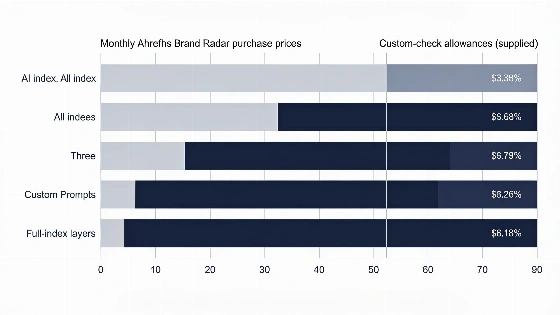
Brand Radar is sold separately from the wider Ahrefs SEO suite. One AI index costs $199 monthly. Access to all available indexes costs $699 and includes 2,500 custom checks. Custom Prompts packages add 2,500 checks for $50, 7,000 for $100, or 25,000 for $250 per month.
Lite subscribers receive 150 monthly custom checks. Standard subscribers get 300, while Advanced subscribers get 600. These prices and allowances are also outlined in DeepSmith’s Brand Radar pricing review.
Checks are consumed by platform, location, and scheduled run. Twenty prompts checked daily across three platforms and two countries use 3,600 checks over 30 days at the standard rate. Claude uses eight checks per execution. With Custom Prompts, users choose questions, then select platforms and locations. Collection can run daily, weekly, or monthly, and the history starts when tracking begins.
That makes custom tracking distinct from the broader index: it follows selected questions on a schedule, while the archived index is refreshed periodically. Individual AI responses can vary between runs, so a trend across several weeks is more informative than a single result.
The public indexes cover ChatGPT and Perplexity. Gemini and Copilot are included, along with Google AI Overviews and AI Mode. Claude is available through Custom Prompts rather than the public index. New Grok collection is paused, though historical data remains. For ChatGPT and Perplexity, Fan-out queries show extra searches returned with a response, not necessarily every search a model ran.
Other reports cover YouTube titles and descriptions, as well as transcripts. Reddit reports track threads appearing in Google results; TikTok is in beta. Access may depend on separate Ahrefs-plan or beta conditions. “Ask Ahrefs” is built into the interface. The agent previously called Agent A is now under Letaido, which offers additional analysis and automation.
Who should pay
Agencies and in-house teams researching several competitors may get more from the archive than a small business monitoring a short list of questions. For the latter, a limited manual review or the smaller Custom Prompts allowance can test whether the findings are useful before paying for the full index. SearchEye’s comparison likewise describes Brand Radar as a broad market-discovery option for Ahrefs customers working with search-backed prompts.
Brand Radar makes answers and source material easier to inspect. It does not guarantee that a brand will earn a citation or recommendation. Modeled impressions do not represent visits or clicks, and they do not measure conversions. Ahrefs describes monthly refreshes for chatbot question sets using a 90-day reporting window; Google’s AI search indexes follow different refresh cycles.








