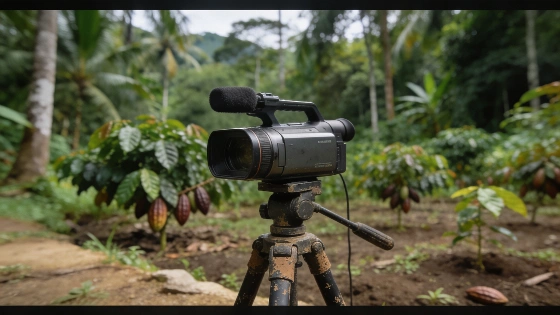
Before Mongabay began testing behind-the-scenes reels in late 2024, its Instagram videos averaged 2,000 to 3,000 views. A reel about pollution from shrimp farms drew about 14,000. The newsroom had found a way to bring an environmental investigation to a larger social audience without relying on its most dependable draw: unusual animals.
Two other early behind-the-scenes videos, from California and Indonesia, each drew about 6,000 views. Mongabay later made videos featuring sources and reporters filming in the field. The figures show a lift for some posts; they do not establish that every reporter-led video will travel as far.
Building the format
Lucia Torres, Mongabay’s video managing editor, said broad audiences on YouTube and Instagram are less interested in environmental content, leaving the newsroom to compete with recipes and music videos. Mongabay’s video operation is part of a U.S.-based nonprofit newsroom covering conservation and environmental science across wildlife, forests, marine issues, governance and environmental policy. Torres drew inspiration for the behind-the-scenes approach from National Geographic, The New York Times, ProPublica and contributing creator Izzy Sasada. Mongabay identifies Torres as video managing editor in its November 2026 short article.
The approach gives stories about shrimp-farm pollution or deforestation linked to cacao farming in Liberia a person and a reporting process for viewers to follow. Mongabay’s short series Stranger Creatures takes a different route: it opens on the wonder of wild animals, then brings in the conservation or endangered-species angle. This mix of written investigations, short-form video, explainers, features and documentaries sits within an editorial operation that also publishes across subjects such as marine conservation.
The newsroom produces roughly 150 to 200 videos a year with four full-time producers and one part-time producer. Its output ranges from vertical clips for YouTube Shorts and Instagram to evergreen explainers, twice-monthly features, investigations and short documentaries. That is a sizable production operation, though the source of its audience differs by platform: Mongabay’s reported figures included about 83,000 Instagram followers, 60,000 subscribers to its English-language YouTube channel and 109,000 followers for Mongabay Indonesia on YouTube.
Reach and editorial choices
Mongabay, founded in 1999 by Rhett Butler as a one-person rainforest news operation, has grown to 150 staff members. It produces original journalism in English, Indonesian, Spanish, French, Hindi, Portuguese, Bengali and Swahili. After its global newsroom, its largest bureaus cover Africa, with 20 people, and Latin America, with 19.
Butler said the newsroom shares audience data with editors and writers so they can consider how audiences respond to problems. In an analysis of 3,422 articles published from June 1, 2025, through August 31, 2026, stories featuring hope or a solution had 41% more median traffic than stories describing only a crisis or threat. Stories classified as action confronting a threat had 43% more.
Those comparisons describe traffic, not proof that a particular framing caused more readers to visit. Butler also said 71% of the 100 most-read stories on Mongabay’s English-language site fell into categories involving hope, solutions, agency or action against a threat. Twenty-one percent were classified as doom only.
Torres said the video team has shifted toward solutions, action, community perspectives and lighter openings, with climate concerns often implicit in the stories. The numbers give the team a reason to test those approaches, but editors still decide how audience response should shape coverage.
The revenue limit
Mongabay’s annual report says almost all its revenue comes from contributions and grants. Butler described event and licensing income as small and advertising as insignificant. He does not expect video to become a material revenue source, pointing to how the business has evolved and Mongabay’s position in it.
He also warned that an advertising-led video strategy can reward views even when the most-viewed stories are not the ones most likely to inform decisions or prompt action. For Mongabay, the reels are an audience-development experiment; the available figures measure views and site traffic, not a new source of meaningful income.