
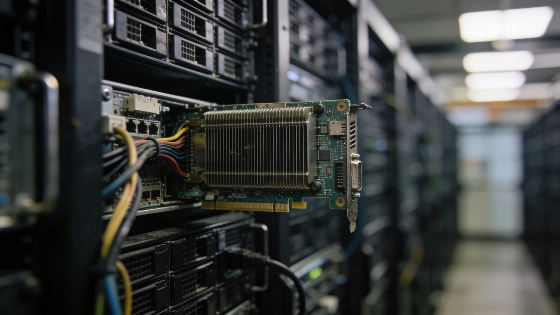
When an ad platform loads a webpage, generating customized material for that user can add computing costs. Microsoft says its Maia 300 chip can deliver 40% more tokens per megawatt than leading GPU systems, a potential efficiency gain for businesses running AI workloads.
A full Maia 300 rack will contain 96 accelerators-twice as many as a Maia 200 rack-and draw 167 kilowatts, Microsoft says.
For advertisers, the appeal is the chance to generate custom copy or imagery for individual users without today’s high computing costs. More inference capacity per watt could let ad systems create those materials as a webpage loads, while using less electricity for the computing behind them. Microsoft also says a Maia 300 rack could deliver up to seven times the token performance of a Maia 200 rack.
That efficiency claim does not amount to a promised price cut. It measures tokens produced per megawatt against leading GPU systems. Whether brands pay less depends on how those gains affect the price of Microsoft’s services. Publishers and advertisers could find individualized creative more practical if computing costs fall, but the savings reaching customers is a separate question.
Microsoft designed Maia 300 as a cloud-scale system spanning accelerators, software, racks, networking and data centers. Its architecture moves from a unified memory organization to NUMA chiplets, bringing data closer to compute blocks.
AI adoption is part of the business backdrop. A report on global uptake described uneven growth across countries. More capable and potentially more efficient inference could give advertisers another reason to build AI into campaigns. The report does not settle questions about how those systems should be controlled.
Microsoft faces Google and Meta in the hardware race. Nvidia is another competitor. Google began developing its Tensor Processing Unit, or TPU, in 2015 and has advanced to TPU v7t and TPU 8i. At Google Cloud Next earlier this year, the company described a split between chips for training models and chips for inference, moving away from one general-purpose design.
Safety is another part of the infrastructure debate. In a BBC interview on Sunday, Microsoft President Brad Smith argued that AI faces fewer safety rules than products such as milk or washing machines. He said Britain should write the rules. Smith proposed safety brakes for AI systems that control autonomous devices, with safeguards in both models and cloud infrastructure. He also cited privacy breach reporting.








