
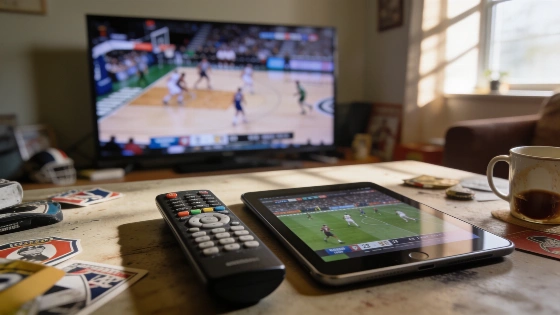
For local advertisers, the biggest hurdle is the price tag: 44% of respondents in a Premion and Advertiser Perceptions survey named cost as the main barrier to greater investment in live sports streaming. Another 41% pointed to measurement and ROI challenges.
Interest is strong. Over the next 6 to 12 months, 73% of surveyed advertisers plan to put budget into live sports streaming and CTV. Among agencies, that share rises to 79%. Reaching highly engaged sports fans motivates 61% of advertisers, while 52% want to tap into major live events. Streaming accounted for 44.8% of all U.S. television viewing in May 2025. Broadcast had 20.1%, and cable had 24.1%, according to Nielsen Gauge figures reported by PPC Land.
The survey points to a buying problem more than an audience problem. Only 23% say reaching sports audiences at sufficient scale is challenging. Transparency concerns 35% of advertisers. Buying complexity worries 34%, the same share that cites access to premium inventory. For local and regional businesses, a large audience has limited value when campaigns are hard to buy or their results are difficult to verify.
Location data can also fall short. In a test cited by AdExchanger, only 23% of residential IP addresses evaluated by InterMedia and Adstra reached the intended ZIP-code target using the tested IP-mapping approaches.
Local measurement needs to start with the market and the campaign’s goal. In the survey, 57% prioritized audience delivery and geographic reporting at the local level, making those the most requested capabilities. Attribution after exposure followed at 52%. Transparent reporting across publishers and inventory sources registered 49%. So did incremental reach beyond linear TV.
Those measures show whether a campaign reached consumers in the intended geography and whether streaming added viewers beyond linear TV. Attribution tracks what happened after exposure. Nielsen’s Big Data + Panel methodology received Media Rating Council accreditation in January 2025. Nielsen also ended stand-alone panel-based ratings for the 2025 television season. Its cross-platform measurement combines large-scale device data with representative panels, then reports deduplicated reach and frequency across viewing environments.
Reporting by individual sport, league, or live event matters to 39% of advertisers, less than market-level measures. The KPI depends on the campaign’s purpose. One may aim to build awareness; another may seek website visits. Store traffic or sales can be the goal instead.
CTV measurement can cover delivery and viewing. Valid impressions and invalid-traffic filtering are among the checks. TV-off detection and viewability are also measured. Completion, reach, and frequency require separate reporting. Geographic measurement can show where viewers were reached.
Outcome measures may include site sessions and qualified inquiries. They can also track sales, return on ad spend, and incrementality. View-through attribution connects CTV exposure with later activity on other devices. Brand-lift studies compare awareness, recall, or purchase intent among exposed and unexposed groups. Geographic-lift studies can examine store traffic. Each approach depends on identity resolution, suitable attribution windows, control groups, and clear disclosure of what the measurement provider observes.
Planning across broadcast networks and cable can add work to a media plan. Streaming platforms and regional sports networks bring more publishers into the mix. Curated inventory and partners who can navigate those publishers can simplify access. The available sports inventory is widening, too. College sports and women’s sports offer additional entry points. International competitions and regional sports do as well, alongside emerging leagues, each at different investment levels. A related focus on advertiser demands for evidence appears in coverage of campaign proof.
Advertisers are also folding streaming into a wider TV plan. Forty percent say they invest in live sports streaming to extend the reach and impact of linear TV campaigns. Another 37% want to connect with streaming-first and cord-cutting sports fans. That favors planning around the fan instead of treating linear TV and streaming as isolated channels.
Nielsen launched Nielsen ONE Ads across 20 markets in September 2023. The service measures audiences across linear TV and connected TV, along with computers and mobile devices.








