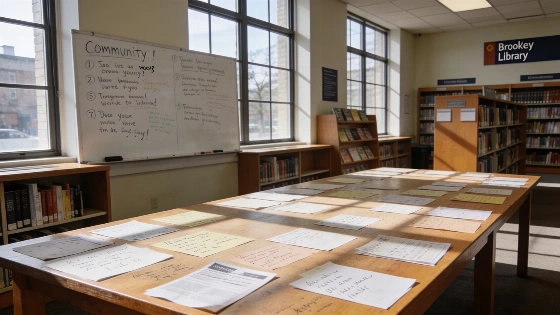
What if the next wave of local journalism doesn’t come from a newsroom, but from your neighborhood library? That’s the idea Terry Parris Jr. is putting to the test with the Library Newsroom Project, which challenges the digital-first mindset that has left many communities with less news and fewer ways to connect.
On September 10, 2026, Library Futures announced a webinar highlighting the Library Newsroom Project as a scalable model for collaboration between libraries and journalists.
Parris Jr. argues that as journalism shifted to digital platforms, it lost touch with the physical spaces where people actually live. He sees libraries as natural partners: trusted, accessible, and already part of daily life. In his view, journalism should be a tool anyone can use, not just a product for professionals. The Library Newsroom Project (LNP) is built to make that possible, giving residents the structure and support to ask questions, find answers, and share what they learn.
Inside the Library Newsroom
The first issue of the Sunset Park Sun started with a simple question from a local pickleball player: when would the neighborhood recreation center reopen? Judith C. tracked down the answer through missed calls, full voicemail boxes, and city bureaucracy. With persistence-and some help-she got a real update from the Parks Department, then shared both the news and the steps she took to get it. The bulletin included a “Resources Used to Find the Answer” section, listing the tools and contacts any neighbor could use. For Parris Jr., this is the project in a nutshell: ordinary people, empowered to investigate and inform, leaving a path others can follow.
According to Library Futures, the Library Newsroom Project is already being used as a working model with active collaborations between libraries and journalists, and is presented as an initiative that can be scaled to other communities.
Scaling the model
The Brooklyn pilot is just a starting point. In Miami, the Naranja Branch of the Miami-Dade Public Library System is working with WLRN to bring teenagers into the project, meeting weekly to learn storytelling and produce public projects. In New Jersey, a $68,000 budget is funding a one-year experiment across three libraries, with the Center for Cooperative Media at Montclair State University as a partner. Boston Public Library is considering a year-long project in East Boston, using existing media-literacy funds to support a local organizer or journalist. Each pilot is trying out different schedules, governance, and partnerships, but all share the same core idea: residents set the agenda, and the library provides the space and support.
Physical products are still central. Parris Jr. insists that every project should produce something tangible-a bulletin, a zine, a map, or an exhibition-that people can find in the library or around the neighborhood. The schedule varies: Sunset Park meets and publishes monthly, while Miami’s teens will produce two major projects per school year. The aim isn’t to copy traditional newspapers, but to create a steady, sustainable rhythm that keeps people involved and sharing knowledge.
Limits and possibilities
Not every kind of reporting fits this model. Parris Jr. is clear that breaking news, investigations with confidential sources, or stories needing legal and editorial backup are best left to professional newsrooms. But he doesn’t want to draw hard lines. With the right mentorship-like the Plymouth District Library’s pairing of residents with retired journalists-community groups can take on more ambitious topics over time. The key is responsible reporting and knowing when to bring in professional partners.
For many communities, the real information gap isn’t a lack of professional journalism, but a lack of connection. Useful knowledge often sits in WhatsApp groups, flyers, or the memories of longtime residents, never reaching the wider public. The LNP aims to bridge that gap, turning libraries into places where neighbors become collaborators, storytellers, and eventually leaders. As Parris Jr. puts it, success isn’t about attendance spikes, but about consistency and ownership-when people start calling it “our newsroom” instead of “the project.”
Other efforts to rethink local information have appeared in recent years, as reported earlier, but the Library Newsroom Project’s focus on physical space and community-led practice sets it apart from digital-only experiments.
Parris Jr. is clear that the LNP isn’t about turning every library into a newsroom or replacing professional journalists. Instead, it’s about making journalistic tools and practices available to anyone who wants to understand and improve their community. Libraries, with their public space, continuity, and trusted relationships, are well positioned to anchor this work. The real test will be whether these pilots can move from one-off programs to lasting practices that communities and libraries can sustain on their own.