Deno’s effort to break from Node.js hit a compatibility ceiling. On October 9, 2026, Cloudflare announced that it had acquired Deno, the company co-founded by Dahl and Bert Belder. The deal is aimed at improving Workers, with no plan to continue Deno as a standalone product, TechCrunch reported. Cloudflare plans to maintain the Deno runtime for one more year before ending its development.
The deal is an acquihire. Dahl and Belder will lead the integration effort alongside 12 colleagues, building a standalone, open-source version of the Workers runtime. The plan is to bring workerd and celld together, then integrate the result with Workers and Durable Objects.
A different runtime model
Dahl sees Workers as a break from servers running at the Linux virtual-machine layer. “Right now, every other server is really operating at the Linux VM layer. That is not what Cloudflare Workers are,” he told The Register.
Workers runs JavaScript inside Google V8 isolates, lightweight sandboxes within a single operating-system process. Durable Objects add persistent state for distributed applications. Each instance is a single-threaded micro-server with a unique global ID. Its storage is co-located, including a dedicated copy of SQLite for session data. Cloudflare can start an instance at an edge location near the user.
“Durable Objects is kind of the perfect distributed systems abstraction,” Dahl said. He created celld after finding that Durable Objects were tied to Cloudflare’s infrastructure. Released in August 2026 as an open-source implementation of the Workers and Durable Objects model, celld was intended to let developers host it elsewhere. It is delivered as a single Rust binary for running distributed applications on users’ own infrastructure. Cloudflare plans to combine celld’s work with workerd, its open-source Workers runtime, to bring the model to customer servers. Kenton Varda originally created the underlying Durable Objects technology.
Why Deno stalled
Dahl introduced Node.js in 2009 after growing frustrated with Apache’s memory use. Built on Google’s V8 JavaScript engine, Node brought JavaScript to server-side code. At the time, it could handle thousands of requests per second using a fraction of the memory Apache required.
Node now powers about 30 million websites. Its 130 million downloads suggest it is also used for many internal operations, although no figure is given for that use.
Dahl launched Deno in 2018 as a rewrite of Node. He designed it to address problems he believed he had left in Node, including through built-in fetch and a permission model. Deno also added native TypeScript support. Sequoia backed the company with $21 million in 2022. As of August, Deno had 400,000 monthly users.
Those figures did not solve Deno’s central challenge: developers wanted compatibility with Node. “What we found over years of working on Deno is that you can't really deviate from Node.js very much,” Dahl told The Register. He said the team backpedaled on some original promises as it sought adoption, leaving Deno as “a kind of an alternative Node.js implementation.”
Cloudflare will provide bug fixes and security patches for Deno during the coming year. Dahl is seeking a new home for the MIT-licensed open-source project. He raised the OpenJS Foundation as one possibility.
From celld to workerd
Cloudflare released workerd as open source in 2022, but positioned it mainly for developer testing. The company had not made Workers fully self-hostable or added the ability to maintain distributed state, capabilities Dahl pursued with celld.
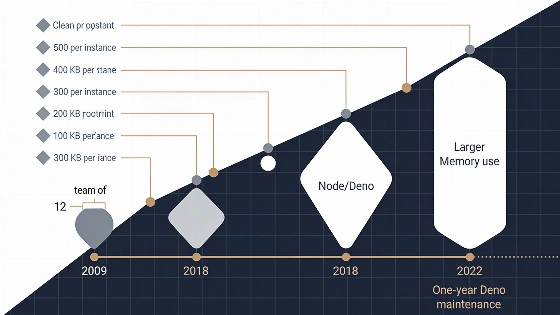
The combined project is intended to become a standalone JavaScript and WebAssembly runtime. Its proposed memory footprint is 300 KB per instance, compared with the hundreds of megabytes that Node or Deno may require. That difference could matter to cloud providers, including those serving the growing agentic market. The new runtime has yet to deliver those savings.
With Deno’s development winding down and Anthropic acquiring and rewriting Bun, Node.js remains the established independent runtime. Cloudflare will maintain Deno for one year during the transition.