
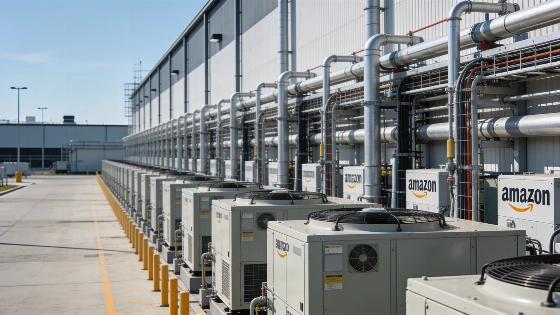
Amazon reported negative free cash flow of $42.4 billion over the 12 months covered by its Q3 results, down from positive free cash flow of $14.8 billion a year earlier. The measure covers a trailing 12-month period, not the quarter alone. Amazon attributed the decline primarily to increased investment in AI infrastructure, including equipment and data-center capacity.
The quarterly comparison had a separate complication. Net income was $20.7 billion, or $1.89 per diluted share, compared with $21.2 billion, or $1.95 per diluted share, in the same quarter last year, when Amazon recorded $9.5 billion in pre-tax gains from its investments in Anthropic. The company said those investment gains were included in non-operating income. The results missed the mark, and Amazon shares fell 7% in after-hours trading Thursday.
That accounting backdrop matters. The prior-year gain lifted reported earnings, making this year’s result look weaker by comparison. It does not erase the underlying operating performance. CEO Andy Jassy told investors that margins on Amazon’s basic business had long been strong and were improving rapidly on the AI side.
AWS was the clearest growth engine. Revenue rose 39.3% year over year to approximately $46 billion, its fastest growth rate in nearly five years. That puts the cloud unit at an annualized revenue run rate of about $184 billion, information from Amazon’s third-quarter results. Jassy said the business could reach $1 trillion in annual revenue within five to 10 years, citing companies moving their basic workloads onto AWS. He also described Amazon’s stores business as a potential trillion-dollar annual-revenue business over that horizon. Those are forward-looking projections, not current revenue measures.
Amazon Ads brought in $19.6 billion, up 12% year over year. Growth remained double-digit, but slowed from 22% in Q1 and 26% in Q2. Jassy attributed the Q3 deceleration to Prime Day moving from Q3 to Q2 and to the absence of NBA games on Amazon Prime Video during the quarter. The pattern resembles the reported Meta ad gains in showing how AI and platform-specific conditions shape advertising results, though the companies’ figures are not directly comparable here.
Amazon is also adding AI tools for advertisers. Amazon Ads Agent, introduced in September, combines the Amazon Ads console with Amazon DSP. The platform is designed to help advertisers create full-funnel campaigns and improve them after launch, drawing on shopping and browsing activity, along with streaming signals, to provide insights, answers and actions.
Consumer use of agentic shopping remains limited, according to Jassy. He said external horizontal agents were not meaningfully affecting Amazon Ads because shopping through them was still “not great” and offered little added convenience over one-click ordering. Few customers were doing much shopping that way yet, he said.








